

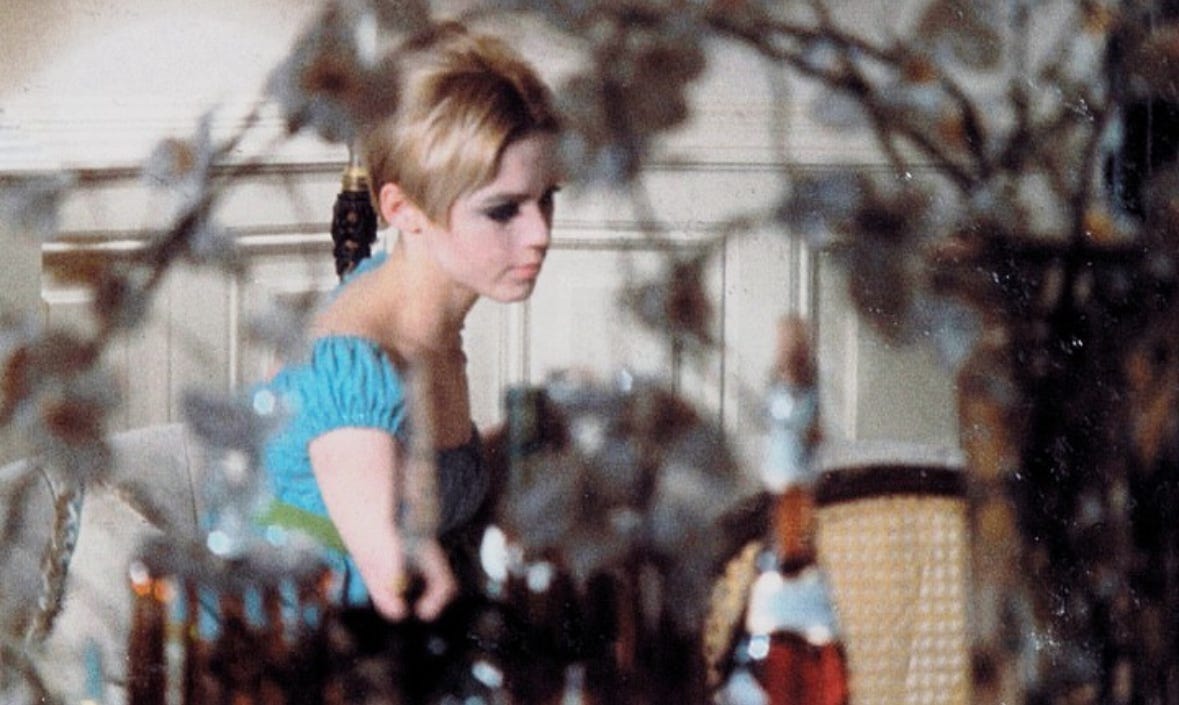
Speaking of those ladies he has made the pop girls of the year – Baby Jane Holzer in ’64, Edie Sedgwick in ’65, and Nico, a candidate for ’66 – Andy feels that ”Edie was the best, the greatest. She never understood what I was doing to her. I don’t know what’s going to happen to her now.”
—Los Angeles Times, May 5, 1966
There are certain sources online which will tell you that Lupe is the last film Edie Sedgwick made with Andy Warhol. This isn’t actually true (she co-starred in The Andy Warhol Story, a two-reeler shot in November 1966, more than a year after Lupe; as far as I can tell, it was not screened publicly in Warhol’s lifetime), but you can understand why people would want it to be: Sedgwick, as a historical figure (rather than a real person, which is, of course, something entirely different), is defined, on the one hand, by her involvement with Warhol and the general New York Downtown Scene of the ‘60s, and, on the other, by her death from a drug overdose in 1971, at the age of 28. What could be more “appropriate,” then, more eerily, morbidly poetic, than for her last film with Warhol, her swan song as a “superstar” of this whole new kind of cinema he was inventing, to be the one in which she plays another glamorous movie star, of another era and another kind of cinema, who is, today, also remembered for how she slowly killed herself with drugs? Sometimes it’s better to print the legend.