

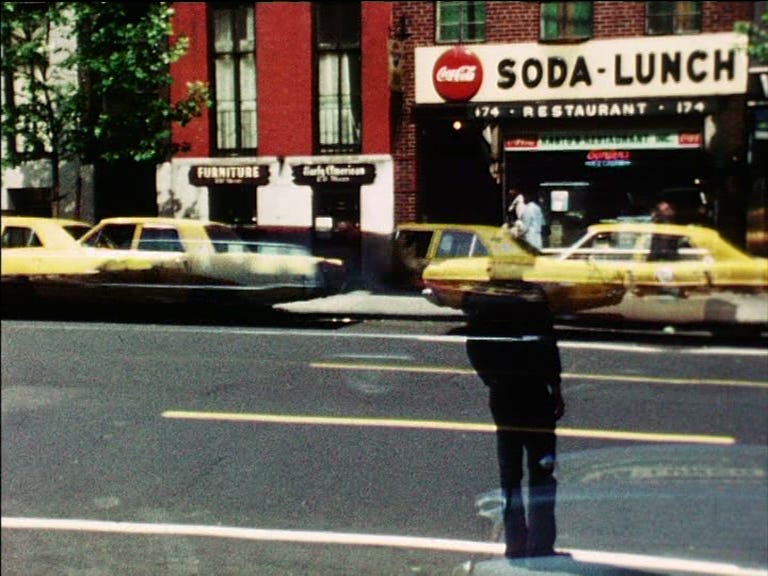
I watched a film called Still recently, which was shot in 1971 by Ernie Gehr, one of American cinema’s great formalists. Still is a fifty-four minute film in which a series of multiple exposures are made on a series of rolls of film, all of the same ordinary street scene, a view of Lexington Avenue across from the offices of the Film-Makers’ Cooperative, where Gehr was working at the time. These exposures are made from an identical camera position (except in one case, where the camera has been tilted slightly upwards) but at different times of day, meaning the setting of the scene (the street, the sidewalk, the restaurant across the way) remains the same, but the participants in this scene (the people, the traffic, the shadows cast by the sun) do not. This creates interesting, at times surprising optical effects, such as ghostly pedestrians walking by in perfect alignment with the very definitely solid ground, or cars parked on the other side of the road which appear to hover in front of passing vehicles. There is a moment where a man crossing the street seems to move both between and “through” some parked taxi cabs simultaneously. Aside from the first two, shorter rolls, which are silent, sound was recorded as well, capturing traffic noises, snatches of conversation, everything you would expect of the hustle and bustle of 1970s New York, which adds a further layer to the experience. In one of the later sequences, not quite at the end but approaching it, one can hear, in the distance, what sounds like a woman screaming – she shrieks once, and then, a few minutes later, once again. There’s no payoff for this, no explanation. The street looks the same as ever. No one seems to pay it any mind. And, of course, why would they? If you’ve ever lived in a large city, you’ll know these things happen all the time. To the extent that the event is notable at all, it’s notable because it was recorded, recorded in the course of creating something that people are still interested watching in 55 years later, after almost everyone depicted, one can’t help but be reminded, has very likely died. Gehr hasn’t, it’s true, but he was still quite young when he made this (about the same age as me, in fact, something I didn’t realize until I looked it up, and which now makes me feel very strange), and he certainly isn’t anymore. He’s part of the old guard now. We’re lucky to still have him around.
As you might have guessed from how I introduced him, Gehr is one of my favorite filmmakers, someone whose aesthetic judgement I have a great deal of faith in and a great deal of respect for, someone whose work consistently displays what I consider an exceptional visual intelligence – but initially, while I was still getting acclimated to the film, the apparent mundanity of the street scene which constitutes Still’s basic material gave me pause: I’m of the opinion that when there seems no particular reason for an image to exist, save be subjected to a particular procedure, it’s fair to question why the image exists at all, if there is any reason why it is this image which is subjected to the procedure, and not any arbitrary other – in short, is there actual substance to the film beyond a concept, the application of a technique, or is it, ultimately, just a more or less sophisticated gimmick? There were quite a few avant-garde films being produced around this time, especially in and around New York and London, which do not meet this benchmark (which, to be clear, is not a benchmark I believe a film has to reach to be worthwhile, some of Peter Gidal’s work, for example, I think is worthwhile precisely because of the arbitrariness of its images, their total meaninglessness as anything other than raw material for his anti-illusionist project – but far more often than not I find it’s to the work’s detriment). As the film progressed, however, as I got a better handle on what it was actually doing, I came to recognize that, as I should have known, this scene, this image was obviously not arbitrary at all – first of all because the location was almost certainly the only place Gehr could have filmed the work at (a brief check of the production history essentially confirms this), and thus absolutely and totally specific, a place like no other in the entire world, radically unique, fundamentally singular, and secondly, more to the point, because it must be mundane, that the work is dependent upon its absolute mundanity. There is normative claim that I think, or at least hope, is implicit in a lot of my critical writing that I’m going to go ahead and try to state as explicitly as possible right here: Art should remind you that life is interesting. What I mean by this is that it should not try to be a substitute for life, or an escape from it, or try to tell you that it somehow stands apart from things, that it’s better, purer, truer than the rest. Rather, it should bring you closer to life, to the world, to the experience of Being, should make you better at living this experience – because it is something you can become better or worse at, something you can learn or forget how to do. Art is enjoined with this responsibility because it has the power to do the opposite, to help you forget that life is anything at all, a capability possessed by little else (narcotics, I suppose, and ideology), and all the great powers of the world, it often seems, are today united in their efforts to direct its energies in this nihilistic direction. And it is as weak as anything in this world, and thus very commonly complies, in letter if often not in spirit, thereby shirking its responsibility and playing its own its part in the soaking of the earth with blood. Gehr used such long takes in Still, I read, because he was frustrated with the sharp, rapid cuts which characterized Vietnam War-era agitprop. “Didactic” is the word I saw used. And so of course it is a completely ordinary stretch of Lexington Avenue which is the subject of the film’s dazzling formal invention – how better to resist the didactic, the proscriptive, than through sustained attention to imagery which, in itself, suggests nothing in particular? One does not need to make the everyday world their subject to make a work which is successful in reminding you that life, your life, the one that’s quite literally happening to you when you’re walking down the street each day, is no less rich in sensory experience, no less worthy of close, thoughtful attention, than anything which you might encounter in a cinema, or a gallery, or in the pages of a book while nestled in your bed at home, that this life of yours is in fact far richer in these respects, at almost any time but certainly when you’re outside, under the sun, than any work of art could be – no, one does not need to make the mundane and everyday their subject to create a work which is effective at this task, but, you know, it certainly helps. And, of course, when one is made to actually sit with it and really study it and observe it, it turns out that this ordinary image out this office window is, in fact, quite beautiful, is rich in visual interest, as almost all ordinary things are when really looked at, the red paint on that one building is astonishingly vibrant, the tree whose lives shine in the sun and rustle in the breeze (one thinks of Griffith, of course) is wonderful, and the cars, and the people… ah! the world! life! the man wearily pushing his food cart across the frame! the man in the leather jacket crossing the street, stopping a woman in her tracks, and going into the café with her! and all those ghosts… all those ghosts…