

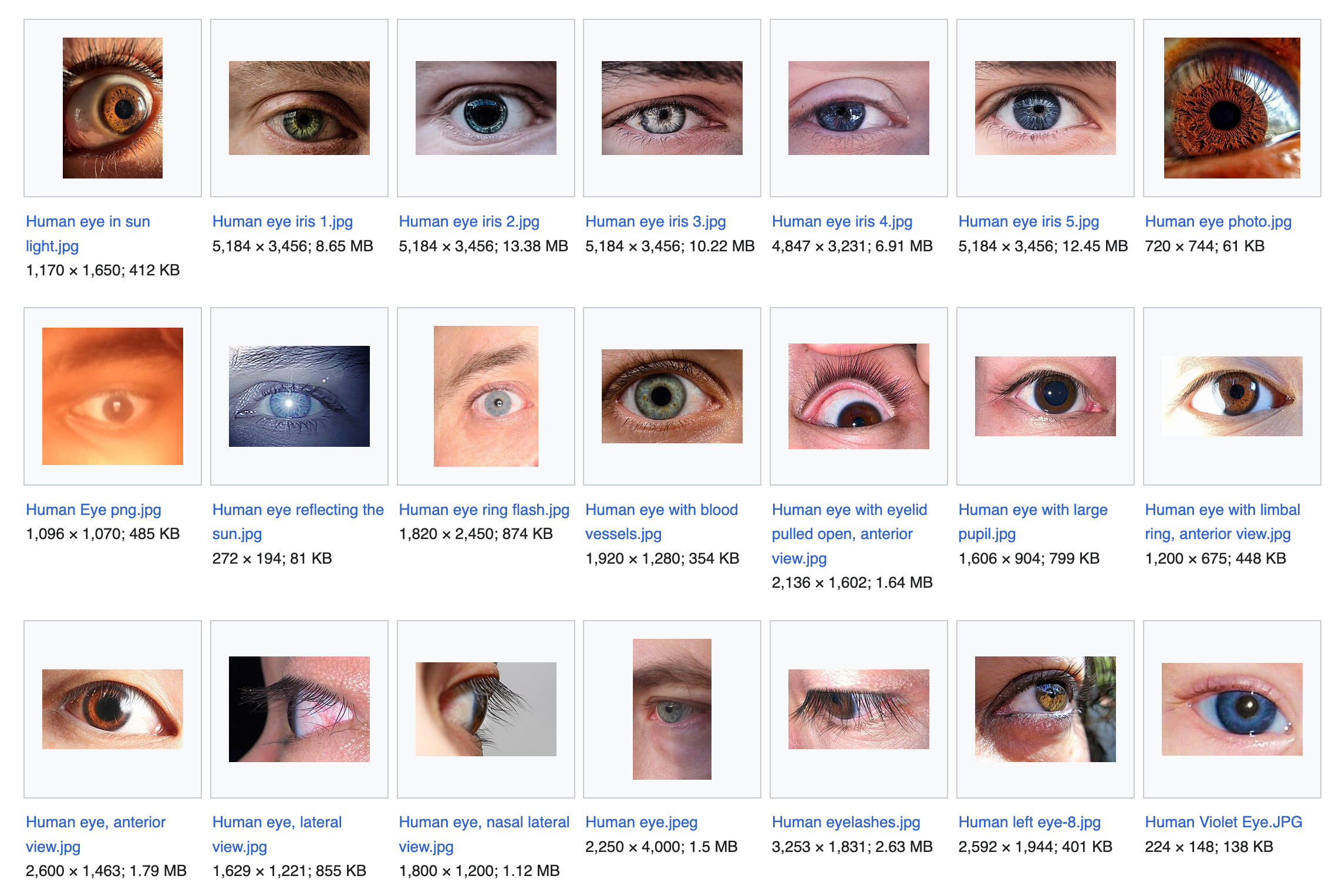
There are 462 images in the Wikimedia Commons category “Close-up photographs of 1 human eye”. In a general sense, it might be said that these images are all the same, and all different. They are all the same in the sense that the nominal subject of each is a single human eye and a small amount of the human face surrounding it. They are all different in the sense that every human eye, like every human face, is irreducibly specific, unique, and singular, and, like all material things, is not fixed or constant, but an ongoing process, within the flux of time, of which a photograph necessarily captures only a single, isolated moment. Thus, in each of these images is depicted an eye in a state which it had never existed before, and never will again – a year, a week, an hour later, it would be a different face, a different eye. Less grandly, it might also be noted that they are all different because, judging by this sample, human ideas about how to take a close-up photograph of 1 human eye are, if maybe not quite so radically individual as eyes themselves, apparently still quite diverse.
Of course, this category doesn’t contain only images which were taken with the express purpose of producing a straightforward reference image of an eyeball: like all Commons categories of any meaningful size, this one is an amalgamation of the intentional and the incidental. While the impetus behind, say, “Eye Central Heterochromia.jpg”, a head-on, crisply-focused flash photograph of the photographer’s own, “blue/grey eye with a hazel centre” uploaded directly to Wikimedia, can, I think, be safely assumed to have been, let’s say, encyclopedically-motivated, the same seems unlikely to be true of, to take another example at quasi-random, “Sleeping angel.jpg”, a shallow-focus, side-on black-and-white image of a sleeping baby’s closed eye and cheek, originally uploaded to Flickr, reuploaded here because it was published (by the child’s father, if the description is anything to go off of) under a Creative Commons license. But even setting pictures like this latter one aside, even considering exclusively those that seem to share the impetus of “Eye Central Heterochromia.jpg”, any true uniformity of aesthetic proves superficial, at best. For one, the eye depicted does not always stare directly into the camera’s lens – it looks off to one side, or slightly up or down, or otherwise evades direct contact. Sometimes this appears intentional, as though the subject felt unable, for whatever reason, to return the address of the mechanical eye confronting them; sometimes it appears entirely accidental, as though the eye is not even aware of its roaming. There are dramatic differences in lighting; even among those using the camera’s onboard flash, matters of lens, aperture, sensor, and exposure settings, along with, of course, the relative oiliness and pigmentation of the subject’s skin, produce dramatically different results. Some of the images are cropped so tightly as to exclude the tapering corners of the eye; others so broadly as to contain the whole of the eyebrow, or even more. There are “anterior views” and “lateral views”. Of the eyes which do meet the camera directly, some stare with unsettling intensity; others gaze with a drooping languor. There is the image (really a series of images) “Postmortem changes of the eye.jpg”, sourced from a medical paper, which in one sense is of a piece with all of these images, is almost as quintessential a “Close-up photograph of 1 human eye” as could be, and in another, of course, stands completely alone, is completely distinct from all other images in the category. For in this image, and no other, is depicted a human eye which we know, by the time it was taken, does not, cannot look back at us, cannot look back at anything at all. Its process has entered a new phase – indeed, the image exists to document this fact. In this phase, the sense of subjecthood has been evacuated; one no longer recognizes in it an address. It makes me wonder: in what sense do these other images, other eyes look back? Do they at all, really? What is it that they see?