

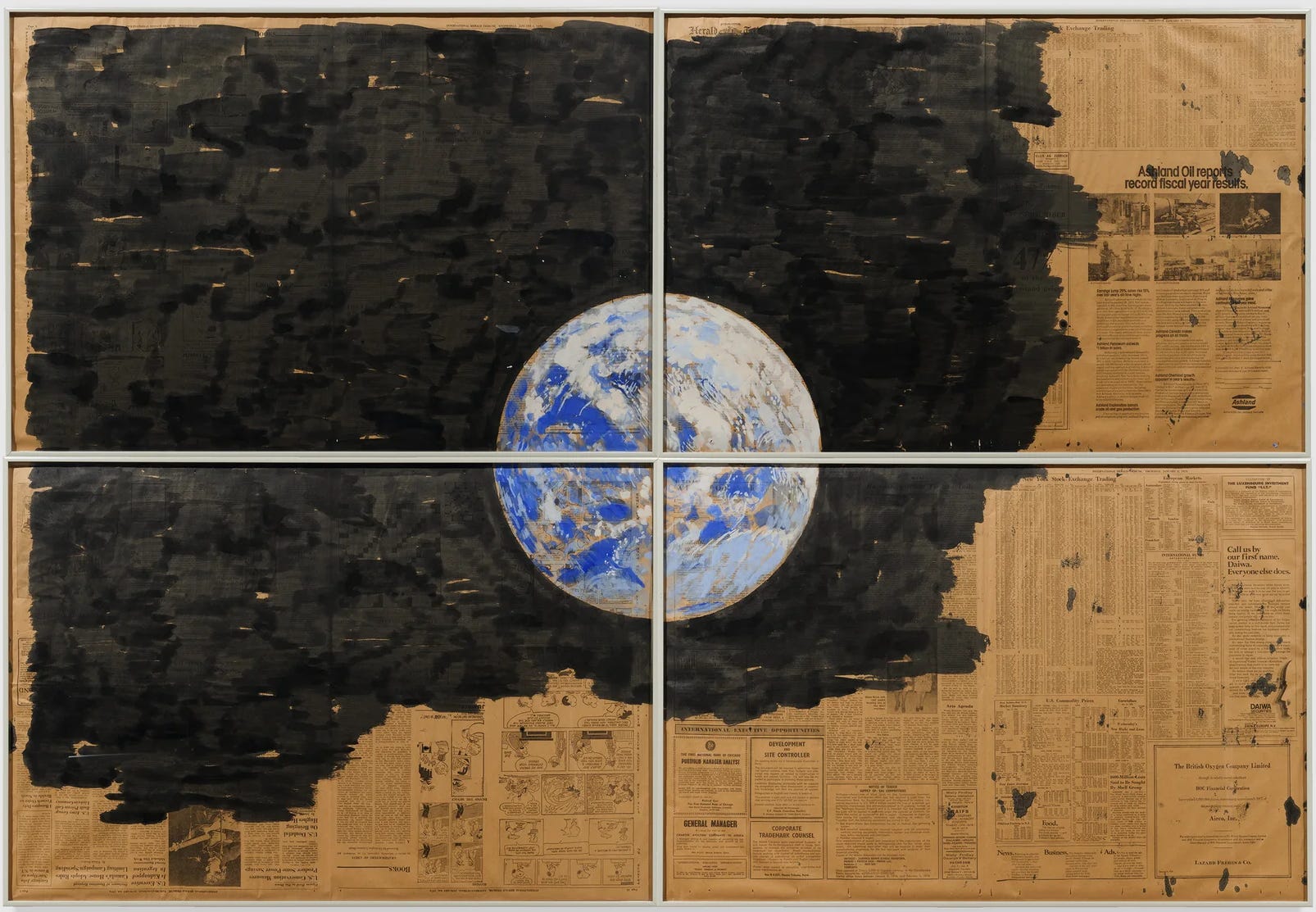
A prefect dream. I’ve found it’s productive for me, as a matter of “craft”, to not really know what it is I am writing, and to know I do not know, and to remain attentive to the ways in which this self-knowledge cathects my unknowingness. In this way, a kind of feedback loop can be generated, where the object of the text is made subject to a process of continual revision, and in so doing is prevented from ever becoming entirely fixed, entirely definite, entirely known. Instead, it remains as it should be: a perfect dream which is always just out of reach.
Skipping stones. I’m always a little confused when writers talk about writing as something they greatly enjoy doing, and even more so when they characterize it as a chore, a great struggle. For me, it just feels like it’s “correct,” that it’s what I should be doing, that it’s good, worthwhile. The process doesn’t make me feel any particular way beyond that. It can be tiring, of course, as any activity requiring sustained concentration can be, and I have days where nothing feels like it’s working, just as I have days when it seems like everything is. And it can be rewarding, too, when I finally find the phrase, the word, the idea I had been groping towards, the one which seems to bring a text into itself, but these feelings have little to do with how I think about what I do, really, or why I keep doing it. It’s not an emotional thing for me, is what I’m saying, although it’s not strictly intellectual, either. It’s something more like the process of searching for a suitable stone on the lake shore, one that I can believe I might be able to skip all the way to the other side, although it never does.
An irony. The fundamental issue responsible for the truly feeble popular understanding of the gallery arts (painting, sculpture, etc.) today doesn’t really have anything to do with the work itself, but rather, quite simply, that one does have to actually go specific locations at specific times to experience it – image files and exhibition catalogues are wholly inadequate substitutes, no matter how many the pixels, no matter how sumptuous the printing. Literature, however, can be engaged with pretty much anywhere at any time; it could not be more accessible. The irony, of course, is that this leads to similar problems, but in the opposite direction – everyone imagines not that they are incapable of “getting it,” but that they surely must be incapable of not “getting it.”
The general contours. Usually (not always, but usually), when I first write something it isn’t very good, or at least I don’t think it is. There’s too many words, or not enough, and many of them are in the wrong order. In some fundamental way, I can tell, the whole thing is intolerably superficial. But I still write it out, I put down the superficialities on the page, I make them into something fixed and concrete, separate from myself, so that an hour, a day, a week, a year later I can come back to it, because only after having let it lie in this way, only after having given myself this distance from it, let it become something which I feel somehow detached, even alienated from, something which, on some level, I no longer recognize as an expression of my own thoughts, my own feelings, will I be able to see what it is I was grasping for with these inadequate words, what matters of substance, if any, were latent in them, matters which I had no hope, initially, of perceiving more than the dim outlines, the general contours of, and how it is that I can reshape these words, such that they might express what they were always meant to.
If you’ve ever met me in person, you might (or might not) have been surprised to discover I’m not nearly as confident or eloquent in direct conversation as I am when I’m “speaking” like this. I’m prone to answering questions in vague, generic ways, allowing things to lapse into awkward silence, generally behaving in ways that imply I would rather not be talking to you, that it’s something I’m enduring, not enjoying – which is not true, probably, I like most people I meet and appreciate it when they take an interest in me. It’s just that I can’t say something, reconsider it, and then replace it with something else in the flow of an actual face-to-face conversation. Whatever comes out of my mouth I’m stuck with, no take-backs, and this makes me cautious, because I don’t want to be misunderstood, and even less to say something I don’t mean. To be sure, there are times when I know exactly what I want to say, just as there are times when I know exactly what I want to write. In these instances, I don’t hesitate; when I know, really know, what I want to do, I do it. But this clarity is rare, at least in my life. More often, it’s a matter of making my way through a fog. That in writing I have the time to stop and retrace my steps, should I find myself wandering from the path I have determined to follow, is no doubt central to my investment in it, why I have always preferred to communicate textually, since long before I decided “being a writer” was what I was going to do with my life.
Violences. A question posed by the filmmaker Marcel Hanoun, from a selection of fragments and aphorisms I recently perused: “Is the violence of images stronger than the image of violence?” – the same question, I think, could be asked of language, and with just as much relevancy. Consider the word “terrorist,” the way it has been made into a label which, for the purposes of empire, renders those to whom it’s affixed legally killable, torturable, not really people in any way that counts. Importantly, the word possesses this power because it is legitimated not only by state fiat, but also enthusiastic buy-in from large swathes of so-called “ordinary people,” viciously resentful of those whose stubborn refusal to cease existing complicates their supremacist fantasies, and eager to be told it is right for them to dream of a great culling, of cities in ruin, children starving, rivers swollen with filth and blood. This, the word “terrorist” and the whole vast discursive framework which gives it its power, within which it is a word, a tool, of great importance, certainly, but far from the only one (cf. “radical,” “extremist,” “parental alienation syndrome”), I think, can be considered the “language of violence” – there is certainly, as well, a “violence of language” which operates quite differently, which has at its disposal a number of quite different tools, quite different strategies (Ahmad Almallah’s work is perhaps a good practical example of this; Bataille would probably be helpful in developing a general theoretical articulation of the concept, even though I’m not as into him as I was when I was 23), but as for which one is “stronger”… I hesitate to say the relation is even necessarily antagonistic; it seems just as often to be purely orthogonal. But then again, even this is antagonistic to that which cannot tolerate difference. It’s important to remember as well, of course, that questions like these have far different valiance for us today than for someone of the May ’68 generation, like Hanoun. He knew a time when the revolution seemed almost within grasp – today, history weighs on our language (and, equally, on our images) very differently.
On poetic traditions. To be a serious poet today, I’m convinced, requires having come to understand that each poem creates its own tradition, a totally unique, brand-new tradition, and that equally each poem belongs to a single tradition, one which is the confluences of a thousand lineages, a thousand and one nights, and which is as old as an infant’s cry, and as young as the wind in your hair. It is necessary to come to understand that these facts are not in contradiction, and that in fact the one depends upon the other for its mortal sustenance. It is necessary, further, to understand that this tradition, the true, old, living tradition, is of such a vastness that a single lifetime is enough to glimpse only a tiny fraction of it. – To be a serious poet, I’m convinced, requires only this, and the discipline to see it through. To be a great poet, however, requires something further, something which anyone can recognize but no one has the right to give a name.
A great read!