

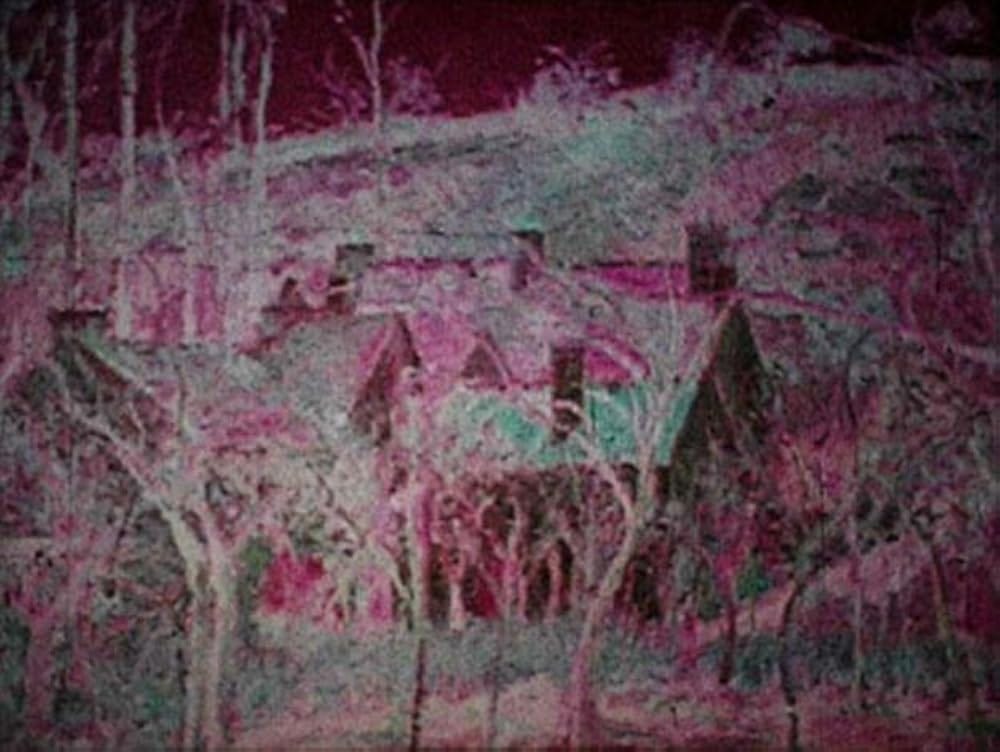
Guy Fihman’s film Ultrarouge-lnfraviolet (1974) is a work that’s been lodged in my mind, not only as an object of thought in itself but as “something I should write about” more or less continuously since I watched it over a month ago. Not at the forefront or anything, you understand, but there, somewhere, in the background, like a dripping faucet. This is in part, no doubt, because it’s a film which I had been interested in for some time, but lacked the ability to see; it’s practically a given that such a film will leave a stronger impression on you, simply because of the way you will have built it up beforehand, and the closer attention you’ll consequently accord it when you do finally get the opportunity. More than that, though, I think it’s because it’s a particularly strong example of a type of work which I find myself drawn to writing about over and over again: that which is utterly straightforward (which is not to say simple), which is effortless to grasp in itself, as you experience it, but which aggressively resists the translation of this experience, this grasping, into critical language. It is not that it’s hard to describe – it is easy to describe: the film consists entirely of a single, static image, the Camille Pissarro painting Les Toits Rouges (1877), an autumnal pastoral scene depicting a small village and orchard in or around Pontoise, outside Paris, to which is subjected numerous “color operations,” that is, gradated transformations of the scene’s color values. A large number of these “operations” are applied to it, separated by black screens. That’s more or less it. It goes on like this for exactly 30 minutes and then stops. No credits or anything. As straightforward as can be. This description, though, tells one basically nothing about what it’s like to actually watch the film, about what it actually does. Therein lies the difficulty.