

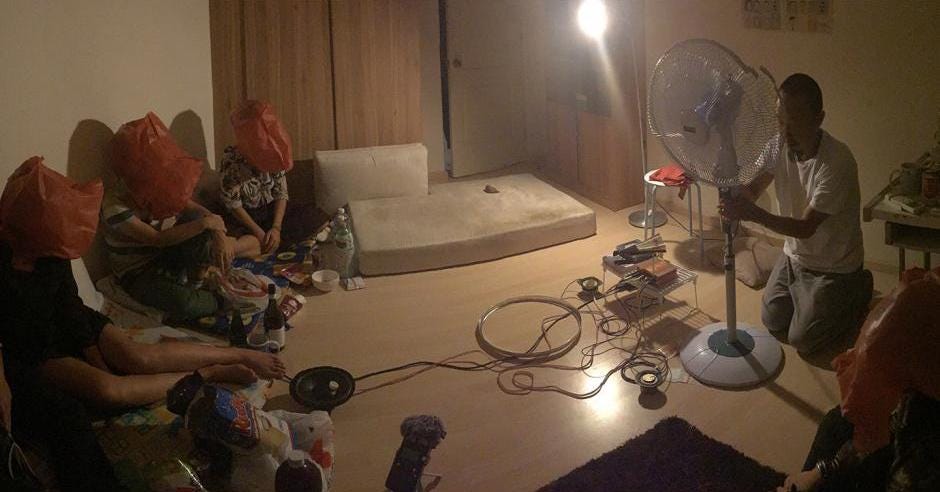
Yan Jun (b. Lanzhou, Gansu, China, 1973) is an artist who works with sound. This is commonly called a “musician”, but the term feels far too limited to encompass a practice as playful, heterogenous, and totally fearless as his, which is as likely to involve him shaking his leg or attaching contact mics to a metal pipe as singing or playing an instrument. If you, like me, are an advocate of the Motern Method, the creative philosophy developed by Motern Media’s Matt Farley which emphasizes, among other things, the importance of constantly creative activity, and the value of following through on every idea, no matter how ridiculous it might seem, you’ll find a lot to admire about Jun, a guy who seems to have arrived at very similar conclusions about process as Farley despite making entirely different work and coming from an entirely different cultural context. One thing this means, of course, is that he’s extremely prolific – more than fifty releases just since 2020, by my count. I thought I would share some thoughts about a few of the most recent ones, from 2025, which I thought were quite interesting and good. All of these are (I believe) recordings of free improv sessions of one variety or another. I’m saying this here so I don’t have to keep repeating it down below, and also because I want the opportunity to make clear that this is not the only mode Jun works in. Like most artists in this sphere, he moves between the many modes of sound production very freely, without sweating the distinctions too much. I think this is an attitude a lot of writers could learn something from – but, of course, so could many musicians, and in any case, that’s a subject for a different time.
Yan Jun & Eric Wong – rely (Infant Tree)
Having recently watched an excerpt from a very similar-sounding recent live performance by this duo, I feel I have a firmer grasp on what’s going on here than I often do with this sort of music: Wong is using a sine wave and white noise generator, presumably hooked up to one or more Bluetooth speakers, and Jun is using his voice and breath (this part isn’t hard to work out). The liner notes, however, indicate this session was recorded way back in 2017, so I suspect what we’re hearing is the result of a less refined and developed iteration of these techniques, or at least Wong’s – environmental acoustics inform what he’s doing here much less significantly than in the performance above, although of course this could just be a matter of the difference between live set and studio recording. It is definitely true, in any case, that the sounds here are very “close”, that there is very little feeling of distance between us and these sound sources. The track titles, “merely” and “barely”, respectively, seem to reflect this this – these are intimate recordings, and they have to be, because otherwise the sounds would hardly exist at all. It is easy to imagine these two men sitting very still, probably quite close together, the picture of absolute focus and concentration. “merely” is by far the more forceful of the two, with Jun producing some seriously deep, droning throat vocalizations, but even the most dramatic of these is quiet enough it would probably go unnoticed in a crowded restaurant. On the latter track, “barely”, he spends a great deal of time in ASMR-adjacent territory, stringing together little clusters of small, damp mouth noises with slow, breathy exhalations and long passages of what could easily pass for snores, if they weren’t so unmistakably controlled and modulated. Wong, meanwhile, seems interested mostly in fleshing out and elaborating on Jun’s vocal gestures, staying in the background, building an austere soundscape for him to explore within. This makes sense: while his palette of cold, perfect waveforms and prickly static fields is in many respects far more limited than the bottomless complexity of the human voice and breath, it can sustain these things effortlessly and indefinitely – it is strong where the body is weak, and vice versa. This kind of holistic dialogic is at the heart of many of the best improvisatory recordings, and while I would not quite rank rely among those (it’s ultimately a bit too withholding, I think, like a locked-room mystery seen through the keyhole), it is still a work of great patience and discipline, very subtle, very involving. I could equally imagine one being calmed or unsettled by it, depending on what they bring into their experience with it – this ambiguity is, for me, a sign of quality.
Yan Jun & Wu Na – Wu Na and Yan Jun (Self-released)
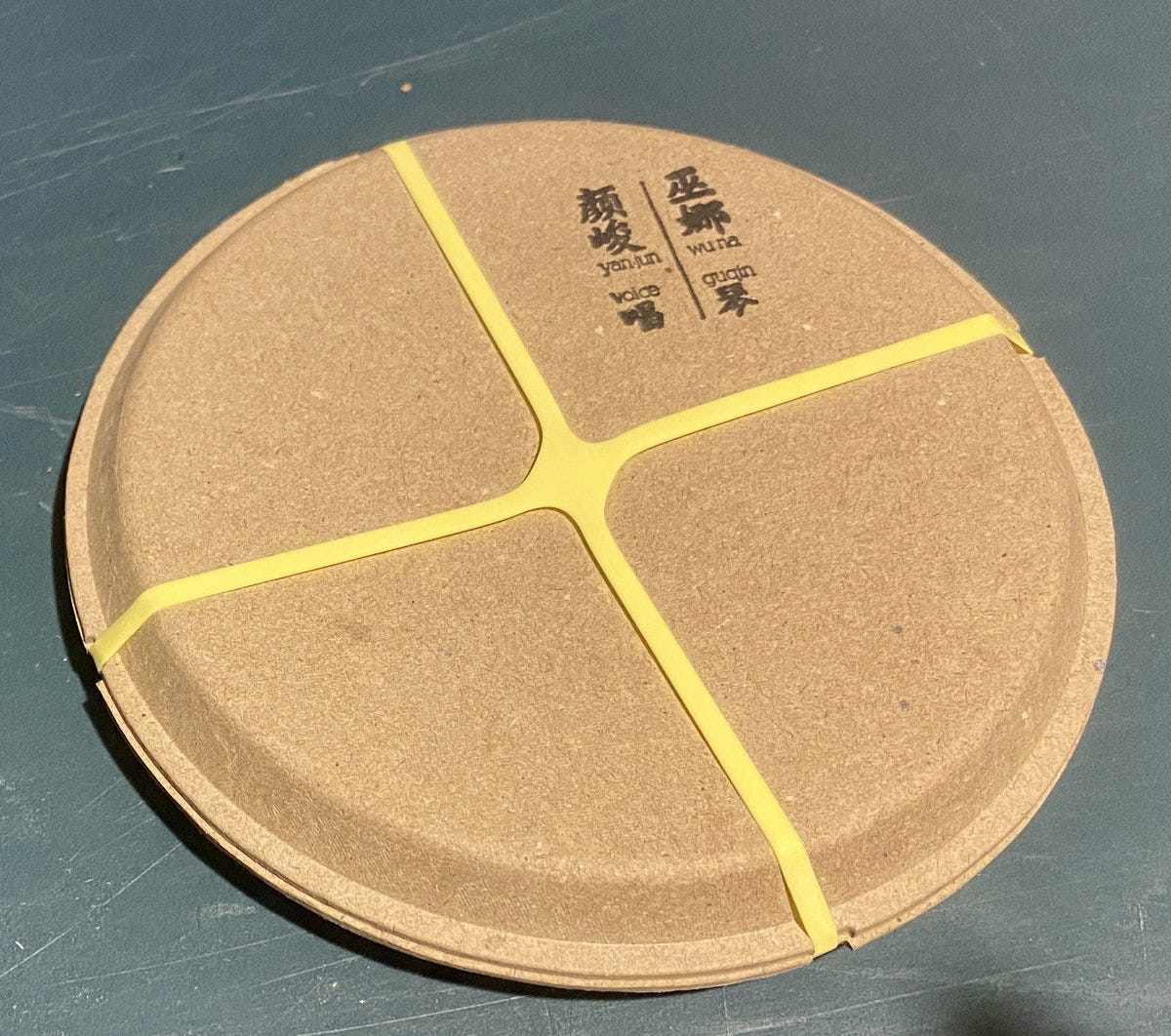
Another duo recording, but of a very different character, demonstrating a very different side of Jun’s practice. Once again, he’s just using his breath here, working with a range of whistles, intonations, and breath-noises, but accompanied this time by Wu Na on guqin. The guqin is a warm, acoustically-rich stringed instrument, totally unlike the austere electronics employed by Wong on rely, and Wu is a highly accomplished, conservatory-trained performer, which means both that she plays the instrument very well, and also relatively conventionally. As far as I can tell, there are few if any extended techniques involved in what she’s doing here – the instrument mostly makes the sort of sounds you would expect it to make, and in the sort of configurations you would expect them to be in. One consequence of this is there is a more definite emotional direction to the music than you’ll often find in free improv; the sounds do not feel so much like they simply exist for themselves, ideas postulated on their own merits – they are coming from somewhere, they are going somewhere, they seem to have something to say. There’s a distinct mournfulness to the proceedings here, or at the very least solemnity. The liner notes include a dedication to a dead friend of the duo (who are longtime collaborators), which suggests this is not coincidental, that there is real feeling here. In basic range, the sounds Jun is making here are not immensely different from those on rely, but their register is entirely different, heavy on long, guttural moans and eerie whistles. These are not quiet sounds, either: in the session’s more intense moments, especially on the first and longest track, you can clearly hear his wails echoing off the walls of the performance space (an art museum in Chengdu), goaded on by Wu’s equally forceful, even menacing quasi-rhythmic figures. The middle track, which has the feel of an interlude, sees Jun incorporating the crinkling of some sort of “foil packet” into the mix, demonstrating a bit of the playful ingenuity that characterizes much of his work, but this is over quickly, and the closing track returns to the same bleak terrain as the first, although in a more subdued now, gloomier, like a ghost wandering off into the moonless night.
Yan Jun & Sara – The World I See From My Left (Tatami Registros)
This is the closest to a full-on noise album of any of those I’ll be discussing here. Jun and his collaborator, Sara, an Uruguayan musician (and founder of the label this album was released on) whose work I’m not otherwise familiar with, are credited as playing, respectively, “feedback” and “objects through pedals”, meaning the sonics here tend heavily towards the most abstract and inscrutable end of the electroacoustic spectrum, a terrain of crackles and squawks and buzzing drones, not so much alien as post-human, post-collapse, hollow shells of buildings and swarms of insects and layers of dust hanging in the air. That a human voice, heavily processed but still unmistakable as such, will on rare occasions surface in this generally inhospitable atmosphere only heightens the effect (I presume these sounds are being made by Jun, but I have no way of actually knowing for sure). To be clear, this is nothing like the Wu Na collaboration – where that record was somber and serious, this is aggressive, it is trying get at you, but it also doesn’t seem like it entirely means it: Jun and Sara want to give you a thrill, show you they can make some fearsome racket, but everyone understands this is ultimately just a show, no one’s getting hurt for real. Maybe this is a weakness, and it definitely sometimes can be in more noisy, dissonance-oriented EAI sets like this one, but I think it works here, because the Grand Guignol affect is counterbalanced by a willingness to really commit to it and actually turn the volume up and get a little bloodcurdling with it. There’s always something going on, another phase shift, another squall of feedback right around the corner. It’s fun for everyone involved. That the record ends with a seven-minute field recording of a “basement” somewhere, mostly consisting of mundane street noise, feels right. A noise show doesn’t feel complete until you find yourself back out on the street, blinking, ears ringing, a little disoriented, hearing the world around you, now, in not quite the same way.
Yan Jun – The Return of the Stupidity (No Rent Records)
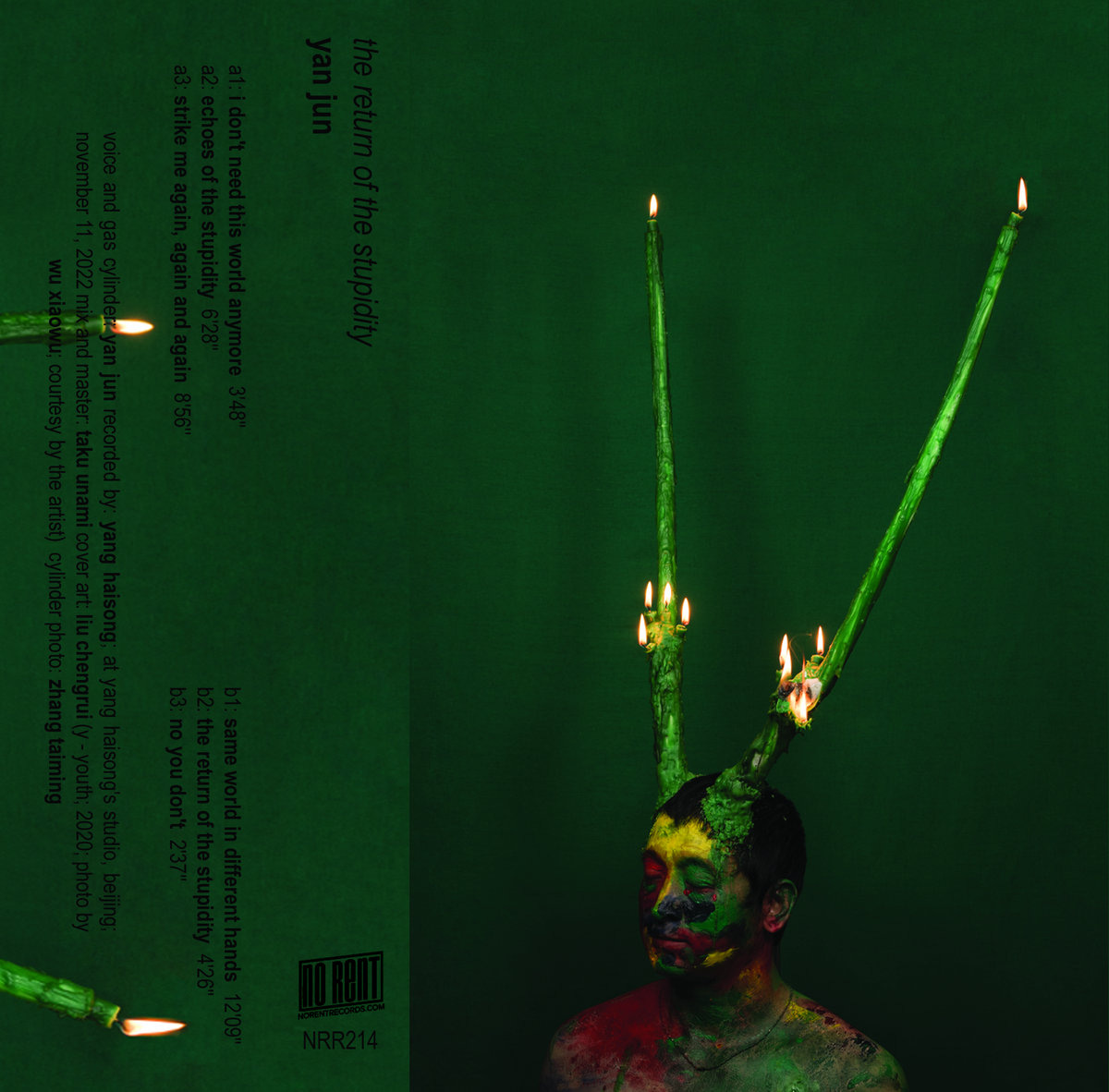
For the record, since I guess I haven’t made this clear already, these albums are just arranged in the order they are because that’s the order I thought it made sense to write about them in. It’s not some sort of ranked countdown; this isn’t a “listicle”. With that said, I actually do think The Return of the Stupidity is probably the second-best album on here, in terms of both significance to what I perceive to be Jun’s overall “project” as an artist and just my plain and simple personal enjoyment. I think it’s probably one of his major solo works, although I still have a lot to listen to, so maybe don’t take my word for it. It’s also almost certainly one of his most intense, solo or otherwise – this is an almost harrowing listen at times, even more so than the collaboration with Wu Na. Jun’s voice is, once again, the central “instrument” here, and this time it really is his voice, primarily, a litany of wails and groans and throat-shredding shrieks which only rarely subside into the subtler breath-sounds (sighs, whistles, inhalations, etc.) that so often characterize his performances in this mode. And then there’s another important, highly unconventional aspect to the sound here: a metallic gas cylinder of some description (the Bandcamp page calls it a “Soviet bomb”. Okay.) which Jun strikes rhythmically, at varying but fairly consistent tempos, throughout most of the runtime. It’s this aspect of the performance which really distinguishes it, suggesting some sort of deep, primordial ritualism. It feels both pre-historic and post-historic at the same time, the first human sound and the last human sound. After all, at the beginning of music, long before the beginning of recorded history, surely, was a wordless cry and a percussive rhythm. But, then, what we are hearing being beaten is not wood, or stone, or animal hide – it is metal, dug out of the ground, melted in a glowing forge, cast into a resonant shape. What we are hearing is the product of industry (of the military-industrial complex, even, if the label is to be believed), modernity, technology, humanity’s millennia-long project of reshaping the earth in pursuit of their own ends. At the risk of overreaching, I’ll declare that in this performance I hear encompassed, in some elemental way, the whole, unfathomable enormity of that project – its basest, purest origins, the great, unknowable loneliness which most likely lies at its end, and the ceaseless struggle which has defined the interregnum between these things, the one in which we are all locked in our own ways. It really is such a lonely work, and so simple, and so deep. In this way it is not unlike time itself.
Yan Jun & Taku Unami – Old Tales Retold (Erstwhile Records)
First of all: this is pretty much an ideal pairing. If Jun is the most consistently inventive and exciting experimental musician in China, then Taku Unami is the most consistently inventive and exciting experimental musician in Japan (I do think there’s some serious competition for both titles, to be clear, but nonetheless, the case could be made). This is without question the most obviously “major” Jun release of the year, not only because of the dream-team matchup, but because of its sheer scale: three discs and three and a half hours of sound. Of course, the nature of the sound complicates things somewhat. This is not a release which sounds monumental, spectacular, etc. – quite the opposite, in fact. Consisting of a single quasi-continuous performance at Inside-Out Art Museum in Beijing, Old Tales Retold is built mostly out of simple, quotidian sounds (footsteps, rustles of clothing, a hand rubbing a dry surface, what might be a ball being dribbled on a hard floor) rendered strange by the echoing resonance of the museum space in which they’re occurring, and the eerie nocturnal quiet which surrounds them. I don’t know the particular circumstances under which this recording was undertaken, but it’s very clear there’s no audience here, that the museum is closed and they’re pretty much the only people there. The album is structured into three “Tales”, each exactly an hour in length, demarcated by a timer that goes off at the end of each of them, and which you can hear being reset at the beginning of the next. It’s an extremely spatially-oriented work, taking full advantage of stereo sound dynamics; at times one performer or the other can be heard running off somewhere very far from the recording equipment – there’s a moment early in “3rd Tale” where it sounds like the panic bar of some heavy door is being engaged, and then a minute later a long, ringing cry, almost certainly from Jun, can just barely be heard as a muffled echo from some entirely different part of the building. The whole work is like this, full of sounds which function as events more than musical figures, as part of a complex dialogue between performer and environment. Really, there’s almost nothing conventionally “musical” to be heard here, which I believe is more or less “the point” – what Jun and Unami seem to be interested in is, rather, the sounds of life, the sounds, especially, of urban environments in which there is always some activity being done, something heavy being dropped or someone singing to themselves or some people playing a game in a courtyard somewhere, and you can hardly guess where, exactly, the sound is coming from, it’s just coming in the open window, it’s just a part of the fabric of the world, and as such something you quickly become used to, stop thinking about, stop reacting to, but of course if you actually stopped and listened, paid attention for a moment, you would find much that was compelling in these sounds, much to hold your interest, and all it takes to demonstrate this is to isolate them, displace them from where you expect them to be, disconnect them from their usual significations while refusing to generate comprehensible new ones. Isolated in this way the familiar becomes strange, the mundane enigmatic – life disconnected from life. The procedure is almost Beckettian in its weird ghostliness, the way it hovers between figuration and abstraction. Between these “Tales”, as well, are two “Intervals” in which Jun and Unami can be heard catching their breath (between the duration and the physicality of the performance, it must have been exhausting), having something to eat or drink, talking in hushed voices and occasionally sharing a joke. The whole thing is bookended by a “Prologue” and “Epilogue” wherein they can be heard preparing for the session and wrapping up afterwards, respectively. This structure is why I referred to the performance as “quasi-continuous” up above – the recording is never paused, as far as I can tell, but can the artists really be said to be “performing” in the thirty-one minutes of runtime that lies outside the purview of the timer? This is one of the things I find so fascinating about figures like Jun and Unami: the “Tales” themselves are remarkably dense and cryptic works, vast accumulations of dry little sounds, footsteps moving to and fro, ambiguous clicks and bangs and rattles, Jun’s ghostly vocalizations – there’s a whole world here, a strange, nocturnal pocket dimension to get lost in. But they don’t want you to forget, either, that all you’re really hearing is a couple guys who enjoy each other’s company running around an art museum banging on things. They don’t want you to forget this is the work of human beings, this is fiction, this is just a story being (re)told.