

Ted Fendt is a writer, translator, and filmmaker from New Jersey, who over the last ten of fifteen years has been establishing a name for himself in independent cinema circles as a director of thoughtful, low-stakes slice-of-life films shot on 16mm, a format which, these days, enjoys the unusual distinction of registering as both proletarian and bespoke simultaneously. I’m not especially familiar with his body of work, but I saw Classical Period (2018) a few years ago, a sharp but affectionate skewering of the sort of literary grad students who have gotten very good at saying intelligent-sounding things about books they might or might not have actually read, and appreciated it for being clearly influenced by and in conversation with more than just other movies, a virtue increasingly rare in the work of self-styled auteurs today, especially American ones. More recently, I watched the three short films with which he began his career: Broken Specs (2012), Travel Plans (2013), and Going Out (2015). I would not say that any of these are great films, not do I think they’re really trying to be. What they are are quite good minor works from the early days of promising career, and as someone who values minor works, as I do all curiosities, obscurities, and footnotes, I thought I would write down a few thoughts about them.
All three of these films are less than ten minutes long, and all three are set in the nowhere suburbs of New Jersey. They all feature a character drinking too much and passing out somewhere inconvenient, and they all end on a shot of someone walking away down the street, held for just long enough to begin to feel uncomfortable. They are all about young people who seem to be going nowhere in particular with their lives, hanging out with other young people that seem to be going nowhere in particular with their lives. These are, then, films which are in some sense about “friendship,” but only a very particular kind of friendship, the kind formed between people who have come to know each other essentially by accident, without really meaning to or necessarily wanting to, by the fact of them happening to have come of age in this particular nowhere place, rather than some other nowhere place. This is a very weak kind of friendship, a kind held together by habit and convenience and very little else. If you grew up in this sort of nowhere place (and this is certainly not unlikely; such places can be found all over America, and, increasingly, the world), you have almost certainly had friendships like the ones depicted in these films, and you very likely can remember a moment from them, perhaps sitting in a booth at a dingy pizza joint burning the roof of your mouth on an unwieldy slice with a crust that tastes distinctly of cardboard, perhaps sitting on a couch that isn’t quite comfortable somehow, watching a show no one in the room really seems to care about, perhaps sitting in the passenger seat of a car, catching a ride home after a night at the bar that ended up going later than you were planning, that you shouldn’t have said yes to at all, you have work tomorrow, or well, technically today at this point, fuck, why do you keep doing this to yourself – at some point, in some situation like this, you have had a moment where this thought has appeared in your head, unbidden, fully formed, ringing clear as a church bell: “What am I doing here? This isn’t where I should be. These aren’t the people I should be with.” These three shorts by Fendt are about the relationships between people who have had this thought and, not knowing what else to do, have chosen to try to suppress it, and those who are, in fact, exactly where they should be, with exactly the people they should be with.
It is important to say that these films are comedies – at their length, they cannot really be anything else, except tragedies, which are, of course, simply comedies without laughter. The first image of Broken Specs (and, by extension, of Fendt’s whole career as a filmmaker) is a guy in a varsity jacket down on his hands and knees in a strip mall parking lot, peering awkwardly under a parked SUV. Its owner, an older man, walks up and says, “Can I help you?” The guy stands up and responds, with a vaguely bovine flatness, “I dropped my glasses.” The older man looks at him, brow slightly furrowed in bemusement, and then says, “I’m gonna drive away now.” Then he does. This is the register all three films work in: a situation is established, it goes nowhere in particular, it ends without resolution. It goes nowhere because it is about people that aren’t doing anything. It ends without resolution because it is not a situation in which resolution can be found. It’s not important enough for that. Nothing they’ve got going on is important for that.
You can see Fendt refining his craft across these three shorts. Broken Specs is a collection of scenes that are connected in only the most incidental of ways, namely that they’re all centered around a particular guy (Mike, the dropper of the titular glasses) and all take place across the same day. He meets a guy he knows and they walk for a while, he has dinner with his parents, he goes to a house party, he drops his glasses again dancing awkwardly in a dark basement and really fucks them up them this time, he passes out at the kitchen table, the guy whose house it is wakes him up, tells him everyone’s gone and he needs to go, too, he walks off into the night. Each of these scenes is a micro-narrative in itself, with self-contained characters and self-contained arcs. The scenes build upon and comment upon each other in an oblique way, the film is more than the sum of its parts, but the thing to notice is these parts are capable of functioning independently of each other, would remain legible as “stories” in isolation, albeit extremely elliptical, minimalistic ones. This is not quite so much the case in Travel Plans, where the action taken in the first scene (the protagonist, Rob, fills out a ticket for an Atlantic City vacation sweepstakes and drops it in the box) rhymes with the action taken in the last scene (he finds a Greyhound bus ticket someone’s dropped on the sidewalk, and impulsively decides to take it and use it), but in between is a series of similarly incidental events: he meets a friend of his by chance, he meets a girl who’s crashing on his friend’s couch, they see the model train set his friend has built in his basement, he meets up with his older cousin for drinks, he passes out on a futon (it’s unclear to me if this is at his place or his cousin’s; it doesn’t really matter, of course), he wakes up the next morning, sits up and stares blankly at the floor. Make no mistake, there is more of a properly dramatic structure here than in Broken Specs, but it’s still mostly just a bunch of stuff that happens.
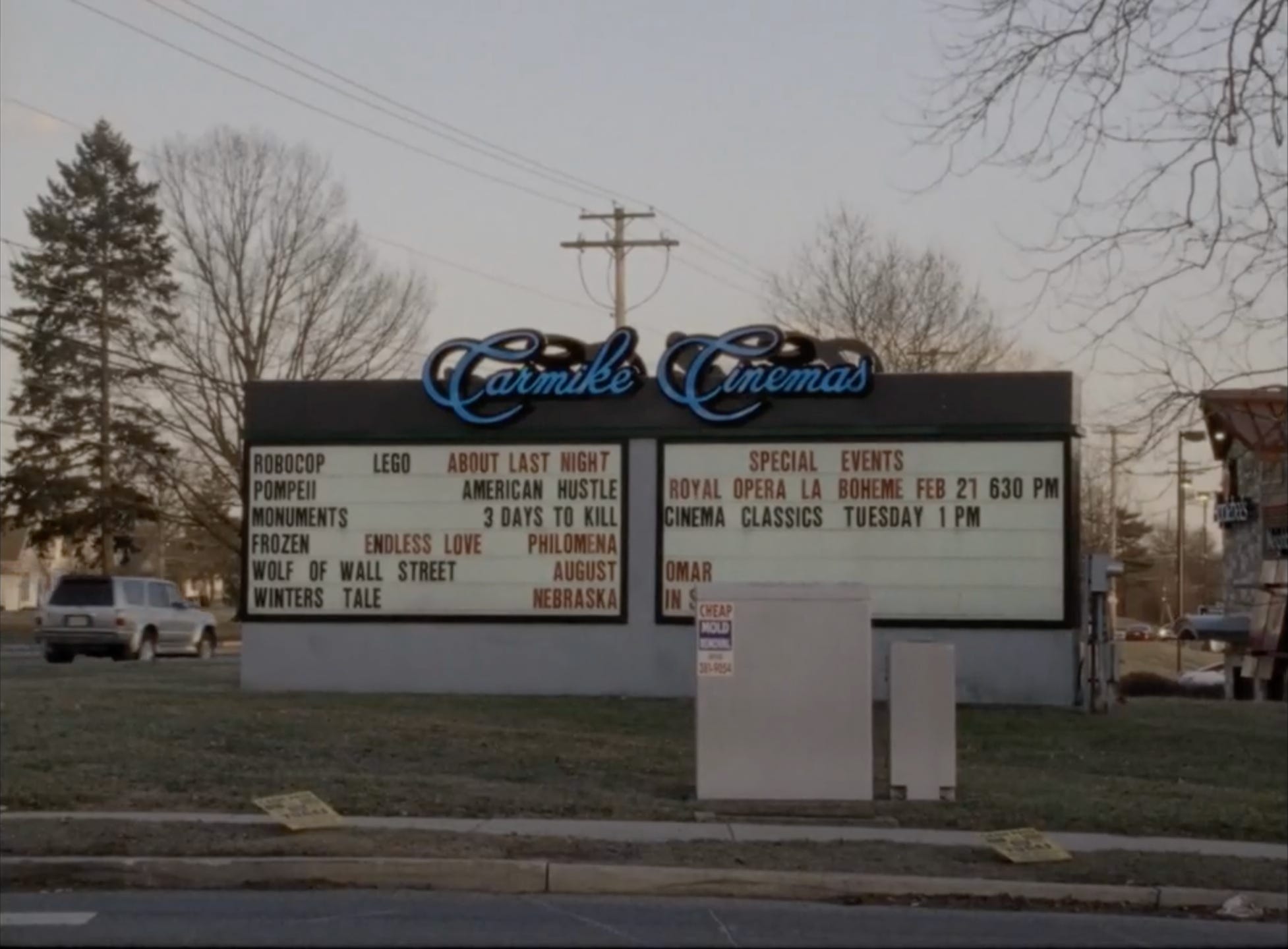
Going Out, though, is not just a bunch of stuff that happens. Rather, it consists more or less entirely of one thing that happens: a failed attempt at a date night, where a girl named Liz asks Rob (the same Rob as from Travel Plans) out for dinner, goes to see RoboCop (2014) with him, and ends up stuck at a bar with his lame friends after he dips early, fending off the wandering hands of the most awkward and rizzless guy in the group, then having to bring Mike (the same Mike as from Broken Specs) back to her aunt’s place after he passes out in the car while she’s trying to drive him home. The next morning he wakes up, gets told he needs to leave, and does. This is the only film of the three which functions as something like a cohesive narrative unit, where almost every scene depends upon those around it not just for thematic resonance or oblique commentary, but basic legibility. Given the reappearance of both of the protagonists from Fendt’s two earlier shorts, I think it’s fair to read the film a bit metatextually, as a something like a reflection on or reassessment of the world and the formal language developed across these three shorts, this mundane little microcosmos that he’s spent the last few years elaborating with such unmistakable fondness and care – he would make one more film in this world, with these people, the hour-long feature Short Stay (2016), and then leave it behind for, it would seem, bigger and better things. I don’t think it’s a coincidence, either, that this is the only film of the three to be centered on a woman, the only one which shows us this world, and the men we’ve already met in it, from a perspective which could not be mistaken for Fendt’s own: if there’s anything “autofictional” to the first two shorts (and they’re so precisely observed, one imagines there must be), then here, it seems, it becomes autocritique. And in making this leap, Fendt’s filmmaking enters into a whole new paradigm, more subtle, more flexible, looking mostly the same on the surface but with much more going on, so to speak, under the hood.
Going Out, then, is certainly the most assured, the most confident, the most fully formed and “mature” of these shorts – but it does not contain the moment which has lodged itself most firmly in my memory, the one which I keep coming back to. That moment, instead, comes from Travel Plans, specifically its final shot. From across the street, we watch Rob, duffel bag in hand, Greyhound ticket presumably secure in jacket pocket, walking towards the bus station. Since he found the ticket, it’s begun to snow, and now it’s coming down quite heavily, thick and gloppy and clinging in wet clumps to anything not salted down. Perfect snowman snow, meaning snow that’s miserable for anyone trying to do anything else. The camera tracks Rob as he comes up to the station, crosses the wide asphalt lot with the busses pulled up at their gates, and disappears inside, behind a high stone wall. The shot is held for a few seconds longer, enough for a car to drive past, enough for us to understand he’s not coming back out, then cuts to credits. The whole thing has happened so suddenly; this whole arc, from the discovery of the tickets to this cut, takes place across less than a minute of runtime. We don’t know where the tickets are for, or what he plans to do when he gets there. In Going Out, of course, we find him right back in the same old places with the same old people, so he probably didn’t do much of anything – but he could have. The opportunity was there. As he disappeared behind that wall, there was a chance that his life might change. It is the only moment, in any of these films, when such a thing seems possible. Although, of course, such things are always possible, if you are willing to admit this to yourself. But the people these shorts are about are not those kinds of people. They’re another type altogether. You know what I mean. You know the type.