

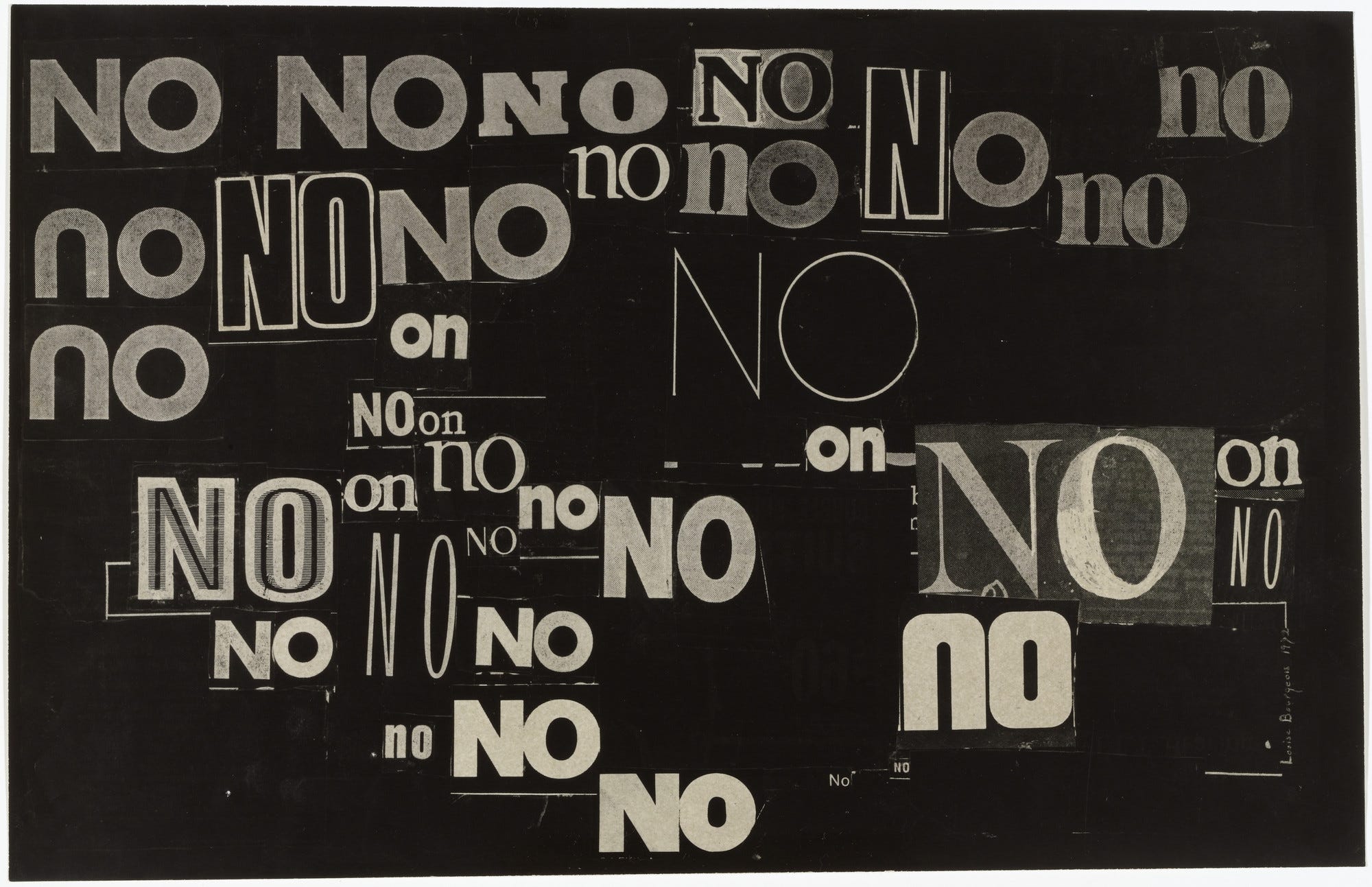
Parallel constructions. Proposal: letter is to word, and word is to text, as pigment is to mark, and mark is to image.
On understanding. When someone says they “don’t understand” a particular work of art, they often mean this more literally than even they themselves might realize: for someone whose idea of sculptural art is limited to heroic figures carved from blocks of stone, one of Duchamp’s readymades, for example, must surely feel as hopelessly inscrutable as a newspaper printed with a foreign alphabet. When someone says they “don’t understand” art in general, however, what they are saying is probably something more abstract: that their idea of what “art” is consistently fails to align with observed reality, with the forms they see it take, the responses they see it inspire in others, the way it seems to actually exists in the world. Both of these problems are very simple to resolve, if the one truly wishes to do so: just let go of the idea. It is an obstacle. forget it, and instead begin from reading the text, looking at the image, hearing the sound – this, and not anything else, is the place from which understanding a work of art begins, because it is the most basic prerequisite for communication, for a relationship, and without a relationship, there can be no understanding. All one really needs is to commit attention to a work, to investigate it, to experience it consciously. The more one does this, the more sophisticated one’s investigations may become, the more refined the tools that can be applied to the task, the more decisively they can be used, but the fundamental process remains the same. There is a division only between those who begin their investigation with the work itself, and those who begin with some “idea” of what it is they expect it to be; beyond that, it is only a matter of degrees, of practice and commitment. It is debatable, rally, if greater sophistication is even always desirable; it’s certainly not always necessary. A small child, after all, has no difficulty “understanding” Matisse or Cézanne – the pictures look pretty, what more is there to say? Confusion about this only emerges as one matures, and all these “ideas” become involved. This poses special challenges for the understanding of literature, which requires, of course, the relative sophistication of literacy to engage with. Many have already become quite tangled in the snarls of their own psyches, their own comforting illusions and sad passions, before they think to give any real attention to the form at all. These snarls can be immensely difficult to extricate oneself from, sometimes the hardest thing one will ever have to do – even though, like Homer and the vending machine, it really is simply a matter of letting go of something. When I was younger, I believed I didn’t “understand” poetry, because I had an idea of what it was, one which I was always trying to fit to the poems I read, and always failing. Once I got rid of the idea, once I stopped trying to “read poetry” and started just reading poems, I discovered I was actually perfectly capable of doing so, and always had been. A general principle: reading, assuming fluency, is really no different from seeing, or hearing, or any other act of perception, and it is these acts which form the basis of understanding. An unrecognized word is no different from a shape the eye doesn’t know how to parse, or a sound which is unfamiliar to the ear. It feels different to us only because it is a skill which we consciously learn, rather than an inborn trait. But these traits can also be consciously trained and developed – this is what a sommelier has done, or any art critic worth reading. The sommelier, of course, didn’t have to learn how to taste something, the art critic how to look at something; they had only to learn how to do these things well. For one who seeks the same sophistication in their understanding of literature, they must train themselves in a similar way, but they must also learn how to read as if they don’t “know” how to read at all, in the manner of the child before a Cézanne. This is the special challenge which literature poses for its understanding.