

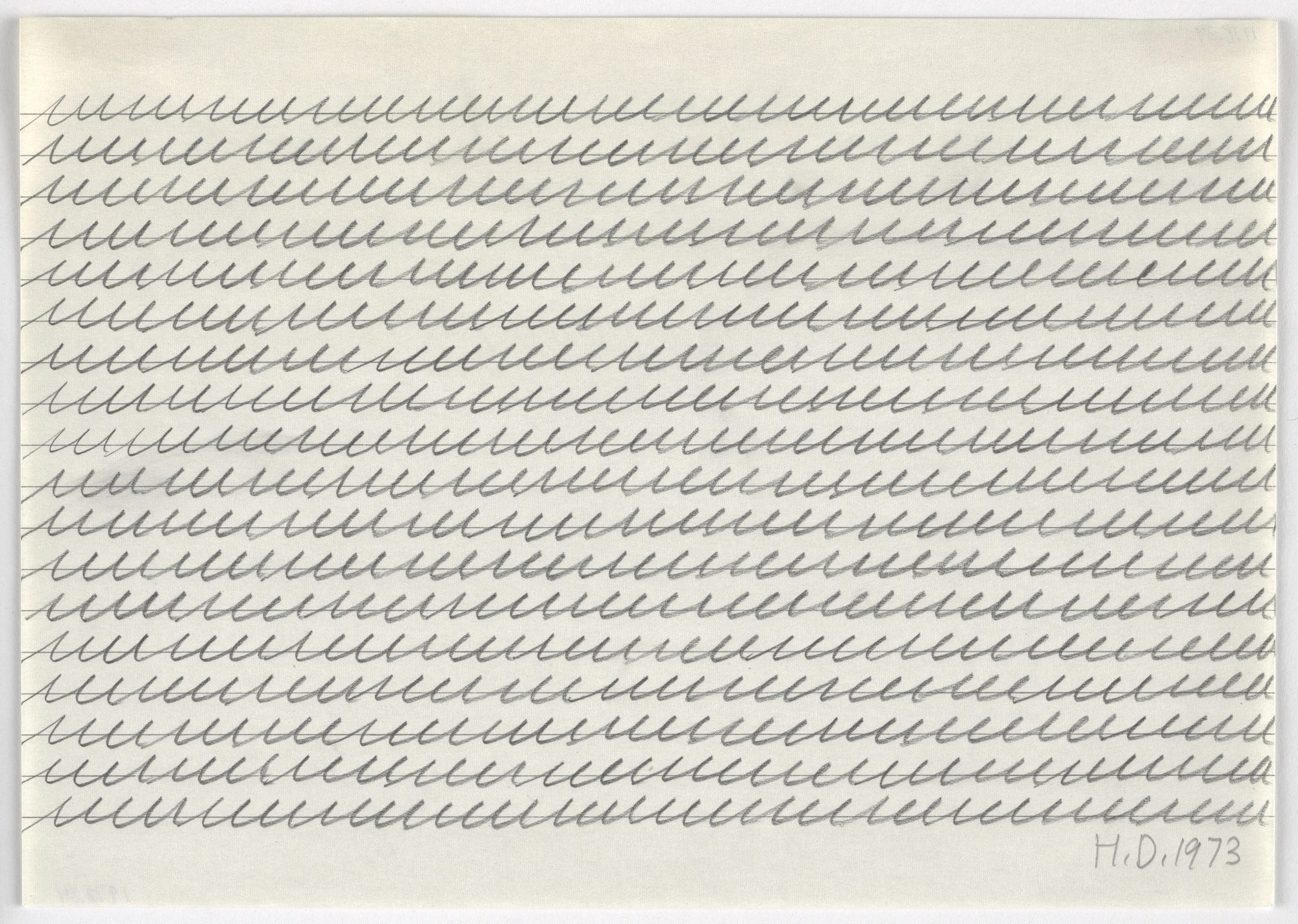
Uncommon measurements. Writing as the art of the distance between “someone was there” and “someone is there.” Usually, we see this distance expressed in an attempt to build a bridge from the one to the other, and we judge the text by the quality of its engineering – that is, by how convinced we are that we can cross this bridge, that it will hold our weight, that it will take us to the other side. Sometimes, however, in texts which are less usual, less ordinary, this distance is expressed quite differently: the void, the gap itself is engaged directly; its span is measured; its emptiness fathomed; it is demonstrated that, really, when we believe we are crossing over it, we are walking on nothing but air, which will only support us so long as we don’t look down, and the other side is only getting farther away.
Aspirations. There were certain artists I encountered as a child whose lives and practices served a kind of tautological function, making me aware, by their example, not only that it was possible to be a certain kind of person, to value certain things, to not value certain other things, but that I was myself already this kind of person, albeit in a still juvenile form, and could not really be any other – even though I had not previously known such a kind of person could exist. In general, it’s my hope that my work might perform the same function in the future, for some of those yet-unborn who will be as badly in need of demonstration-by-example as I once was, to see that there is precedent for their sensibilities, to see that there are many ways their lives can go, that there are more options than they might have guessed. But when I write, my aims are much more straightforward: I hope, simply, that someone will get what I’m driving at.
Kinds of smallness. I’m hardly the first person to notice this, but there is a strange bifurcation occurring in the literary ecosystem today. On the one hand, in the more prestigious zones, the ones inhabited by people who are, generally speaking, finding ways of scraping by without a day job outside the culture industry, doorstopper tomes are clearly “having a moment” – the longer, the more imposing, the more “difficult” a book is, the more it seems to dominate the conversation (at least until enough time has passed that it becomes reasonable to expect one to have actually read it before commenting on it). On the other hand, in those zones inhabited mostly by those who are not making a living off their writing, maybe because they’re not established yet, or maybe because they’re too weird and dysfunctional, or they live in the middle of nowhere, or they’re not interested in playing the game, or, yes, maybe because they’re simply not good enough, they’re just hobbyists, whatever, there is an unmistakable trend towards smallness – towards the microfiction, the aphorism, the poem of just a few lines, the line of just a few words. Certainly, I’m not immune to the allure of such forms, would even say I feel some degree of partisanship towards them – it is, after all, the “fragment” which I’ve made my chosen vehicle for these thoughts. Further, the artists I’m interested in, the ones I draw the most inspiration from, are much more often the sort who work constantly, obsessively, producing dozens or hundreds of minor works along which will sometimes turn out to be major ones, than those who slave for years or decades over a magnum opus, a Great American Novel, et cetera. I am a believer in the body of work, the cumulative effect of an oeuvre, not the singular masterpiece. On these grounds, I would love to welcome this proliferation of smallness. But I can’t. I can’t, because the smallness which much of this writing possesses seems to me borne out of a desire to make literature into something which can fit more easily into the present attention economy, something which can be read and metabolized in a few minutes, if that, which asks no more of your time than an Instagram Reel – in a word, it is unobtrusive; it is writing which seeks reconciliation with an illiterate culture. I hope I do not need to tell you that this is not something writing should try to do. It is cowardly, it is futile, and furthermore, it is a total waste of the actual powers of literary smallness, powers ably demonstrated by Kafka, of course, but also Lydia Davis, Yasunari Kawabata, Emily Dickinson, Richard Brautigan, Li Bai or any number of the great Classical Chinese poets, of course many others besides, whose small works, at their best, produce an effect akin to seeing, by chance, a small beetle or ladybug crawl onto the open page of the book you are reading: a sudden shock, a sense of a change in the air, a heightened awareness of all things around you, which will linger for days in the back of your mind, working a slow, subtle change in your being. It is this effect which one should strive for, if one is going to work in this way; literature should be obtrusive, and there is no reason why a jeuju, say, will be any less so than an epic of a thousand pages, if it does not compromise itself, if it is not the work of someone who is embarrassed to be something as old-fashioned as a writer, who is embarrassed to be taking up your time – in short, if it is the work of someone who is not afraid.
The general thrust. If you’ve ever turned the subtitles on while watching a movie (or a TV show, or whatever) in a language you can speak, you might have noticed something: they do not always directly correspond with the spoken dialogue. Not only are speech disfluencies (“uh,” “um,” etc.) or quirks of cadence usually not transcribed, the substantive language is itself sometimes modified – usually, this takes the form of simple compression, the jettisoning of relatively unimportant nuances to make the general thrust of the line more immediately apprehensible, but sometimes the alteration is more severe; if you watch enough material this way, and you’re paying attention to it, you will sooner or later come across a subtitle which you feel outright misrepresents the line it corresponds to, omitting a crucial detail, say, or compressing an extended monologue to the point of fundamentally changing its meaning. I don’t mean this as a criticism, really, or at least not of the individuals doing the subtitling; I understand these are industry-standardized practices, and that they’re just trying to maintain what I’m sure is a difficult balance between accuracy and fluidity. There is certainly some “social commentary” one could indulge in over what studios, broadcasters, and subtitling companies consider “too much” for their audiences to follow, but what I find more interesting is how becoming aware of these modifications affects one’s perceptions of subtitles for media in a language one doesn’t speak.
Everyone understands, of course, that no translation is absolutely “literal” – no word means exactly the same thing as its “equivalent” in another language (the German “Apfel,” say, does not have exactly the same resonance as the English “apple,” if for no other reason than that the presence of that “f” changes how we experience saying it and reading it, and therefore how we relate it to what it signifies) – but when we read a work of literature in translation, we presume in good faith that the translator has sincerely attempted to represent as fully as possible, by one rubric or another, what the source text is, all its complexities and nuances, even if this is ultimately not really possible, or requires straying rather far from a “literal” translation of the original words. Unless something gives us cause to question the translator’s judgement or ability, we read the text they have produced trusting it can serve as a reasonable basis for drawing conclusions about the original. But this is not the case for subtitles, properly understood: with subtitles, one must assume compromises have been made, that you’re getting the general thrust of the line, its basic meaning, but not necessarily its full significance, its poetry, its gracefulness or awkwardness. I find this interesting because it results in a very peculiar sort of reading – aware that the words I’m seeing do not correspond exactly to the speech I’m hearing, but not able to understand the speech itself, the subtitles become a kind of “middle text,” a general approximation whose omissions and elisions I have try to read “through” to build up a fuller sense of the original text in my head (using, if possible, what I can understand of the speech itself to refine my interpretation). This is, I think, a significant part of why foreign films so often seem more “cultured” or “refined” than ones in a language we do speak: not only does a language barrier help to mask deficiencies in an actor’s performance, it also helps to mask deficiencies in the writing of the film itself, because, when we watch something with subtitles, we judge it not on the basis of the actual text itself, nor, really, the simplified translation the subtitles deliver to us, but rather an “ideal text” which exists only in our heads, produced by our attempt to fill in the gaps between what we can understand and what we imagine is really being said, a text which, because it is one we produce ourselves, informed by our own particular sensibilities, and because it remains amorphous and superpositional in the way all unvoiced thoughts are, will always seem better to us, at least a little bit, than that which actually exists, in translation or otherwise.