

I hate writing about “discourse,” which is cheap material useful only for the production of disposable thoughts, so I’ll try to establish the context here as quickly as possible. For two or three days earlier this month, a bunch of people I follow were arguing with a bunch of people I don’t follow over whether “Gen Z” is as “creative” as previous generations – if it’s meeting its artistic benchmarks, so to speak. The specific inflection point for this discourse seemed to be when this one guy (nevermind who, it it doesn’t matter) claimed there were no “new genres” of music being created anymore. It’s an easy claim to mock, and the guy who made it was clearly, to some extent, simply in denial about not still being as tapped in as he was ten years ago. It’s trivially disprovable in the sense that you can go on RYM and find plenty of “genres” in its database with release histories that begin in the 2010s or early 2020s. But the more I thought about it, in that accretive way one does when seeing the same arguments being restaged again and again on the timeline, the more reluctant I became to dismiss it out of hand, in the way I saw others doing. Eventually, I came to the conclusion that while there’s obviously no real basis for saying the generation which is currently in its teens and twenties is in any meaningful sense “less creative” than any earlier generation was when they were in their teens and twenties (how could such a thing possibly be quantified, anyway, given the overwhelming amount of historical variables you would have to somehow control for), in a narrower sense the sentiment actually resonated with something that’s been on my mind a lot lately. Here’s what I ended up posting:
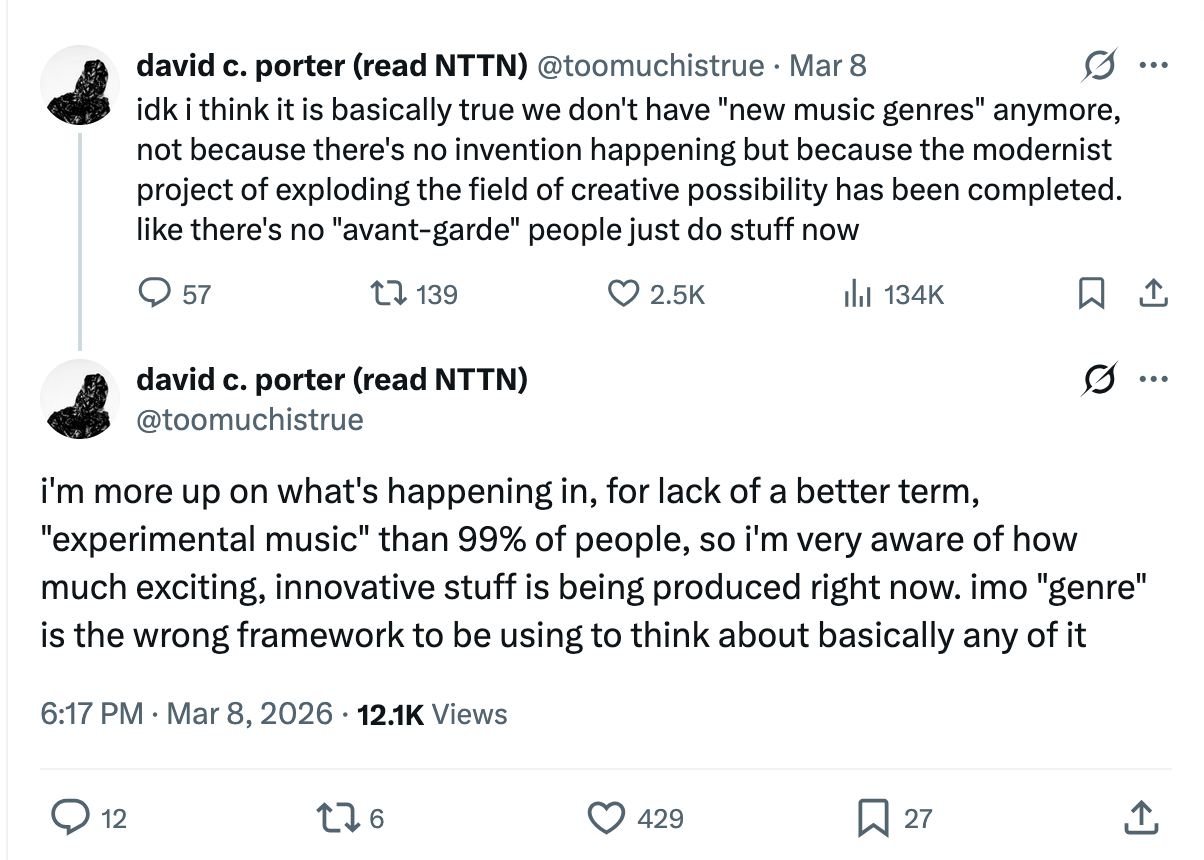
Obviously, it’s not really possible to fully elaborate a position with this many moving parts in a couple tweets (thus why I’m writing this). Still, I was a bit surprised by how consistently the responses to it missed the point – the variations on “you’re just out of touch” were wrong but understandable, there’s no real way to prove the extent of one’s musical knowledge because any attempt a) makes you sounds like the Merzbow Boredoms Gerogerigegege copypasta, and b) can be instantly negated by a disparaging reply from some guy who knows more (and there’s always someone who knows more), but some of the other common rebuttals were more frustrating, because they weren’t so much countering the argument as failing to understand what it actually was. I’m not about to write an essay picking apart why random, specific people on the internet were wrong like three weeks ago, I’m not that much of a dork, but I do want to flesh out my argument, because I think this stuff matters for anyone making or thinking about art today. So, instead of sniping at my quotetweeters, I’m going to focus on what I think the two main weaknesses or, more charitably, ambiguities of my initial formulation was, that enabled these misunderstandings. The first of these, I think, is in my usage of the term “genre,” the second in the nature of the distinction I drew between “the avant-garde” and “just doing stuff.”
I’ll start with “genre,” because it’s the more fundamental one, and the one I knew would cause issues if the posts gained traction (as they did). I knew it would be a problem because it wasn’t really a word I wanted to use, but that I had to use anyway, because it was the term on which the whole discourse hinged. The problem is “genre” is imprecise in a way that hopelessly muddles things, especially in regards to music. In common parlance, a musical “genre” can equally be understood to refer to a scene, a style, or an idiom, among other, even more amorphous categories (such as “movement” – yikes!), but it’s really only idiom that’s relevant to the question here. Someone asking “Why aren’t there any new music genres?” is not likely to reconsider their premise upon learning that, say, the hardcore kids from this one area code have been playing way sludgier than the hardcore kids from the area code next door the last few years, even though this certainly qualifies as a “scene” with a new “style” – because, of course, hardcore kids are still working in the idiom of hardcore, regardless of how they might tinker with it, and that idiom is well-established. It’s the expansion of idiomatic possibility, and only this expansion, which is generative of the sort of “newness” being sought here; my argument is that this expansion does not meaningfully occur at the level of “genre” anymore.
Jazz, I think, is a good case study for what I’m trying to get at here. Apologies in advance for the massive oversimplifications I’m about to indulge in, but work with me here: Jazz represented from the very beginning a significant break with and challenge to the musical conventions of its historical moment. Further, the development of new sub-genres like Swing, Bebop, Free Jazz, and Modern Creative all significantly expanded the form’s idiomatic umbrella, and, by extension, the field of what was considered acceptable as “music” in, again, their respective historical moments – in a very real sense, they made something possible which before had not been. But these developments, of course, all happened decades ago, and since then Jazz has become increasingly academic and provincial. There’s still plenty of great Jazz musicians out there, of course, and plenty of great Jazz music being made, some of it quite forward-thinking and unconventional, but it’s not like it used to be, and everyone knows it. There aren’t going to be anymore seismic paradigm shifts – how could there be? Charlie Parker already happened. John Coltrane already happened. Cecil Taylor already happened. It’s not that these men were such Promethean geniuses that none can hope to follow in their footsteps (although they were, of course, Promethean geniuses), but rather that their footsteps are there now. To quote the daughter of a certain post-Keynesian development economist, you exist in the context of all in which you live and what came before you. Any genre boundary a young musician might want to test, they’ll find others have been there before, and still others who have gone even further, past its breaking point, just to see what lies beyond (Brötzmann and Bennink’s Schwarzwaldfahrt is a good example of this in a Jazz context). It’s important to emphasize these are not boundaries of convention, except in so far as “genre” is intrinsically a matter of convention, because beyond them is not anything forbidden, anything which is “just not done,” but rather just another genre, another form, another idiom, as legitimately “musical” as any other.
Really, what the problem is with “genre,” in the context of this “Gen Z creativity” discourse, is it’s a concept that’s not quite abstract enough to get at what the discourse is really about – namely, “Why do I feel like art isn’t like it was in the 20th century anymore?” My position is that the answer to this is really very simple: there is no “undiscovered country” anymore, in any major art form. As I alluded to in my initial posts, the history of art from, let’s say, around 1850 to the turn of the millennium is one of the systematic probing, and eventual overcoming, of every conceivable boundary and convention regarding what art can be. There is, at this point, no line which has not been crossed, no limit which has not been pushed to the point of arbitrariness (cf. Cage’s 4’33” and ORGAN2/ASLSP, Malevich’s Black Square, Kubelka’s Arnulf Rainer, Craig-Martin’s An Oak Tree, Saroyan’s “lighght”). Some of the areas opened up by this are much less thoroughly mapped than others, of course, but the conceptual boundaries have been discovered, and there’s nowhere within them which has not, at least, been glimpsed in passing by someone following some line of creative inquiry. To refocus on music in particular, it is the reality today that any and all conceivable arrangements of sound can be integrated, to some extent, into an existing idiomatic context; some arrangements can be sorted far more granularly than others, but no arrangement cannot be sorted at all. Everything is permissible, nothing is unprecedented. In large part, it was successive waves of formal and conceptual provocation tied to various scenes, movements, and technological/intellectual convergencies which got us to this point, and the products of these contexts are usually either actively or retroactively codified into “genres” – thus, it’s understandable why one might take the continued vitality of this process of codification, or the lack thereof, as being meaningfully correlated to the vitality of the art form overall. But this is a mistake. In our present situation, where the limits of music are, in practice, barely distinct from the limits of sound itself, “genre” becomes increasingly irrelevant as anything other than an index of known, historical idioms, a catalogue of frameworks which no longer possess any real proscriptive power, any say over how the forms and ideas developed through and within them might be deployed, or by whom.1 With no frontier left to be expanded into, then, every “new genre” tends increasingly towards either an exercise in the arbitrary recombination of existing idioms (cf. Electroswing, and most of the stuff people replied to me with as “counter-arguments”), or, in its search for some plausibly novel idiomatic niche, becomes like a flower forcing itself up through a crack in the sidewalk, contorted, nutrient-starved, likely to be be crushed, probably sooner rather than later, under someone’s careless shoe (cf. Seapunk, the rest of the stuff people replied to me with). However, it doesn’t to any degree follow from this that it is no longer possible to be “original” as a musician – quite the opposite, there has never been more it is possible to do with music, never more options available. The difficulty, now, is that when one can do basically anything, one has to actually choose what they want to do.
This brings me to the matter of the distinction I drew between “the avant-garde” and “just doing stuff.” I think the failure here was much simpler, and much more a matter of genuine ambiguity in my phrasing. Some issues were definitely caused by the implicit assumption I made (but shouldn’t have) that it’s generally understood “the avant-garde” is not some sort of eternal vanguard of Art, but rather a historically contingent phenomenon constituted by specific conjectures, many of which I believe no longer hold, for reasons broadly outlined above – this conclusion is certainly contestable, and I recognize the broader argument is going to be non-obvious to someone who hasn’t had “Always historicize!” properly drilled into them. But really, I think the main thing people didn’t understand is this: I don’t think there’s anything wrong with “just doing stuff” – it’s definitely better than trying to “be avant-garde” these days. I think that really, it’s the only serious option left, if one wants to do anything truly meaningful as an artist. It’s precisely this situation of extreme choice paralysis that’s been preoccupying me lately, a situation engendered by the totally open field of creative possibility which now exists, thanks to the decades-long efforts of the historical avant-garde, and one which, today, emerging artists in any discipline must come to terms with. It is no longer the case, as it was in the last century, that you can write yourself into the history books, or at least into a sustainable career, by simply finding some clear and obvious taboo and violating it – there aren’t any left. There are still cultural orthodoxies, of course, but to survive in this environment they’ve made themselves resilient as cockroaches; if you want to do art-as-critique, you still can, but doing it effectively won’t any easier than making worthwhile art of any other kind. There’s no shortcuts left – you have to actually do the work. And doing the work means… just doing stuff.
Obviously, this is both a blessing and a curse. It feels incredibly liberating to be able to do anything, right up until you have to actually choose what it is you want to do. This is why, despite how apathetic the phrasing might sound, I don’t believe “the avant-garde” being superseded by artists “just doing stuff” represents some sort of cultural loss or degradation – rather, it is the correct response to the present conjecture of those who, in an earlier period, would have been part of that period’s avant-garde, and that the work they’re producing now is no less worthwhile than the work they would have been producing then. It’s just that the context has changed, and so, necessarily, has the work. To be a good artist now demands a different sort of confidence now than it did when one could get fed up with the tastemakers, pen a manifesto, and go from there – everyone is a tastemaker now, and everyone is fed up with each other, and so none of it matters. You have to start by actually doing something now, by finding a way to make something that you can believe is better than nothing, that is not pointless, that is not just an empty repetition or regurgitation of what’s come before. From there, if you really must, you can work backwards towards the manifesto. What matters, really, is believing that your preoccupations are worth being preoccupied with, and not getting so hung up on defending this belief that you become unable to produce the body of work which will actually prove it. This is the confidence required today, and this is what I mean when I say the best artists now “just do stuff.” To be clear, I’m not trying to advocate for some sort of primal, “intuitive” approach to art-making with this – a lot of the artists I have in mind here (I’m not going to name any names, sorry, I’d like this piece to have a shelf life of more than a couple years) are actually hyper-intellectualized in their practices, and beyond that, it would be missing the point to advocate for any particular approach at all. Like I said above, there are no shortcuts anymore. There’s no one size fits all. You have to decide for yourself what you want to do, and you have to do it to the hilt, and you have to be ready to shift gears in an instant if you feel it stop working. This is the real difficulty, the real precarity of making art today: you can’t stay in one place, the way a genre does – you have to keep moving. It’s for this reason, among others, that I believe Duchamp has probably never been more relevant, more exemplary a figure.
I feel like I’ve repeated myself a lot in this piece. I guess it’s that, while the point seems very simple to me, I’m aware it’s something a lot of people will be very resistant to, because it runs up against their own ideas of how these things work, and people don’t want to hear what they don’t want to hear, so I find myself trying to clarify it over and over again, coming at it from all different angles, trying to patch up every little hole where misunderstanding might leak in – I’m sure that I’ve failed, I think that as an essayist I’m often very messy, but, you know, at least I try. I understand the resistance: it’s a very reassuring idea, for any aspiring artist, to believe that there’s still somewhere out there where no one has been before, and that if they can just find their way to it, they might change the world. But such a search, today, will only lead to disappointment and frustration. Being an artist today, like being in the world today, means living with other people, in a discovered country, speckled with ruins and shelters and monuments, criss-crossed by innumerable roads, highways, footpaths, narrow dirt trails that run through dark woods and climb over bare hilltops – a world still full of mystery, certainly, but mystery which is due as much to our forebears as anything innate in the soil. Today, the only truly novel thing which remains is the only thing which has always been novel, and always will be: the relation each individual forges with everything around them, and with everything which has come before them, and everything which they imagine as coming after. But really, what more do you need? What more could you really ask for?
Adding this as a footnote because trying to integrate it into the main argument would make everything hopelessly belabored, but the dynamics I’m describing here obviously become more complicated when applied to a more “story-driven” form, such as literature or film, where the course of history itself, whose continual flux constantly produces novel social relations, seems to serve as an inexhaustible source of “new” generic modes; while I would say that generally the formal techniques employed to tell these new stories are almost always decades or (in the case of literature) centuries old, and that, in any case, they will still fall within some idiomatic precedent, not beyond it (i.e., they will not be Finnegans Wake, they will not be Ivan the Terrible, because these things already exist), I will also acknowledge that for art forms like these, it is probably appropriate to imagine the idiomatic terrain I’m describing with an additional temporal axis, one whose true limit remains unknowable.
fwiw I don't think you've failed. your initial point seemed reasonable to me, but I can see how it may have appeared controversial. the exposition clarifies the argument. navigating 'the discourse' these days demands that we're constantly zooming in and out, slowing down, speeding up and shifting perspective – precisely because everything is already everywhere all the time. i would possibly argue that 'genre' has never been the domain of the artist – only the critic. and perhaps the entrepreneur. but it seems to me that the artist's concern has always been to just do stuff.
So what would you say the last idiom is? What was the last one we needed to get all the pieces in place to finish the map? Was it hyperpop?