

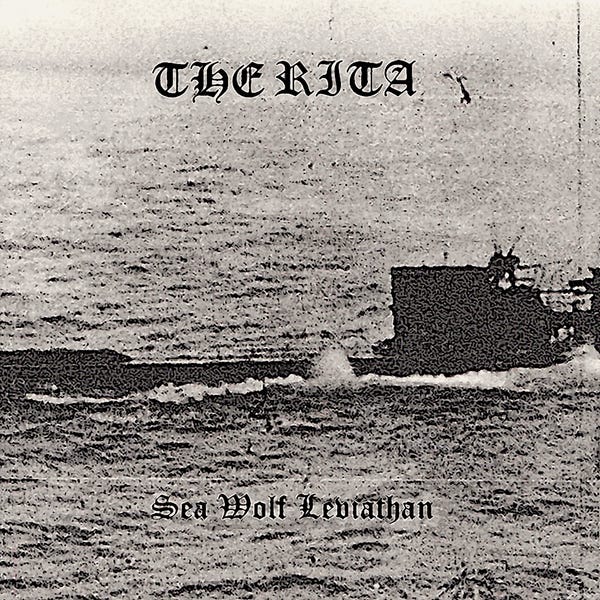
One of the difficulties in writing about noise, especially wall noise, is the temptation to use the thematics implied by the (at times elaborate) packaging of a given release as the basis for interpretation of the work. To a certain extent it’s necessary, as a matter of critical diligence, to consider such things: an album is not just sound, but a physical object packaged and presented in a particular way; this presentation is part of the release, the two are not separable, each, on some level, informs the other. I bring this up as a roundabout way of saying that there is an easy way to write about Sea Wolf Leviathan by The Rita, which is one of the great masterpieces of wall noise. Here is the easy way: the album is called Sea Wolf Leviathan. It has a grainy, black-and-white picture of a submarine on the cover (or, more precisely, the original, 2004 Solipsism CD-R release does; I actually own the 2023 Cruel Symphonies cassette reissue, which uses conceptually similar but aesthetically distinct naval imagery). This image and this title together suggests certain thematics clearly enough to develop a workable reading of the actual sounds within – this album is about deep ocean, screeching iron, rushing water, constant, crushing pressure, “diving”, torpedoes, etc. etc. Insert here a few hundred words vaguely alluding to drowning, World War II, claustrophobia, man and nature, whatever. You get the idea. Review complete. And in a sense this is a fine enough way to write about the album: Sea Wolf Leviathan really does kind of sound like these things. It’s supposed to sound kind of like these things – that’s what the picture is telling you, that’s what the title means. Sea Wolf Leviathan is, consciously, intentionally, about fucking drowning, and it’s hardly being coy about it. But if it were a different picture on the cover, a different title, is it not possible that one might find it equally easy to say it sounds like whatever that picture and that title suggests? The original release also includes a semi-pornographic image from a kitschy Satanic ritual – a woman, nude, sitting on a cloth-draped table before a goat’s head in a pentagram, knees up, legs spread, eyes closed, a robed figure pushing an ornate goblet towards her. Another nude woman stands by, watching, holding an unlit candelabra. Is Sea Wolf Leviathan actually about Satanism, then? Perhaps what we are hearing is actually meant to be the howling of demons, the cries of the damned… you see what I’m getting at?
This is the thing: generally speaking, noise walls sound like noise walls. They can also sound like other things (wind, static, rainfall or snowfall, etc.), but those things are all ultimately secondary to the fact of the thing itself, in the same way a cloud’s resemblance to a mountain or a human head is secondary to its fundamental cloud-ness. If we are going to write about Sea Wolf Leviathan seriously – and I believe we should, I believe this is serious art worthy of serious engagement – it is necessary to affirm this primacy, even though it makes the task of writing, of criticism, of interpretation, exponentially more difficult. No shortcuts: if we are writing about sound, we must engage with sound, not just the frame that has been placed around it. That the noise wall is an especially abstract form of sound, especially resistant to enclosure within language, makes it all the more necessary to stubbornly insist upon this point. To do otherwise is to refuse, if not to really hear the work, then, at least, to put any of that hearing into writing – to claim to be writing about sound when really you are writing about images, words, people. And there’s nothing wrong with writing about such things, of course. They are worthwhile subjects. The frame matters, the frame tells us something about what’s inside it. But an image is not a sound. A word is not a noise. If you become confused on this point, you’ll never manage to say anything of substance.
Sea Wolf Leviathan, then, is a wall – or, actually, two walls, each a half hour in length. These walls are the same and not the same at all, in the way two large, unpolished slabs of stone cut from the same quarry will be the same and not the same at all – the same material, the same dimensions, but run your hands along their surfaces, and you will discover innumerable minute differences, discover each is a pocket galaxy of tiny bumps and ridges utterly distinct from any other. What is remarkable about Sea Wolf Leviathan, among wall noise releases, is the rich complexity of this surface – there are dozens of layers of noise worked into these walls, low rumbles, mid-range hisses, high-pitched squeals and scrapes, none quite the same as any other, all constantly rising from and falling back beneath the baseline roar (the particular texture of this roar is the main distinguishing feature between the two tracks; it’s a bit crunchier on the first). It is a masterpiece of mixing, always in the red but never muddy, never monotonous, always teeming with activity. The density of incident is dizzying; if you actually tried to listen to it, as one would, say, a classical composition, tried to track how the sound moves, how elements are introduced and discarded, the interplay between its frenetic micro-level and glacial macro-level, you would be completely overwhelmed. There is too much happening, and nothing happening at all. Both tracks begin and end without ceremony, blocks of sound that are immediately exactly what they will be for their entire runtime, even as they constantly shift and transform. There is a moment around nineteen minutes into “Blechholler”, the second track on the disc, where most of the upper layers are stripped away, and for a few moments there is just a clicking, stumbling bass rumble. Then all that weight, all that din of scraping and screeching and scouring comes back in again, feeling somehow even louder, even more punishing. After it’s over, the silence feels unnatural.
I suppose it’s a little perverse to want to write about work like this in this way. You’re supposed to simply be overtaken by this sort of thing, to submit to it, to let its weight crush you, excoriate you, purge you of your thoughts. You are not meant to try to make it legible, to make it an object of study. Everything about it resists the procedure. The words all feel so hopelessly inadequate, they have nothing to grab onto. There is no arc to trace, no development to chart. It just happens until it stops. That’s it. But Sea Wolf Leviathan is important to me, and writing is important to me, and so I persist. I want what I do to be capable of speaking to what this album does. I want to make it work, I want to find the language which is adequate – I want to bridge the gap. This is, I suppose, just a particular manifestation of a much larger preoccupation of mine: how to address in language that which is not experienced through language, that which belongs to an entirely different register. I am preoccupied with this not only because so much of what is important to me, in art and in life, belongs to this category, but also because I believe language can do so much more than is generally permitted to it, and I am stubborn about trying to prove this to myself. There is always a risk of failure in these efforts. I recognize I’m drifting increasingly far from my subject here, out into open water, far away from the gray solidity of the shore. But I’m not afraid of drowning. I must not be. I have a purpose here.