

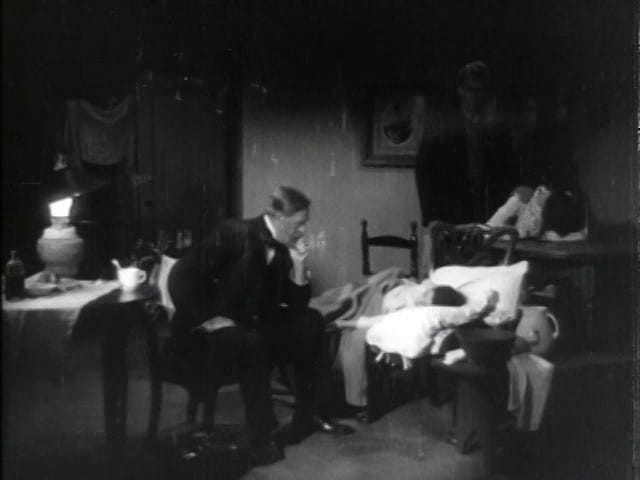
I watched The Doctor’s Dream the other night. The Doctor’s Dream is a 1977 film by the great Ken Jacobs, recently departed and sorely missed, which consists of the re-presentation in its entirety of an earlier film, a dramatic short subject concerning a country doctor’s efforts to save the life of a little farm girl who falls deathly ill after walking barefoot through some stagnant water, with the only intervention being the reconfiguration of the shots into a new order. This original film is not very good, frankly, an unremarkable bit of rural kitsch which would have already been creaky and antiquated in the 1970s, to say nothing of today. There’s essentially no reason to watch it unless you’re a scholar researching a very specific thread of American culture. It’s obscure enough that, while I found a source giving its name as, reasonably enough, The Doctor, I wasn’t able to dig up any information about it beyond that, no plausible entry in any of the major databases – the closest result was a silent adaptation of the same source (a painting which I’ve never heard of, but which a promotional sheet for said adaptation confidently asserts “is doubtless familiar to all of you”) that features a sick little boy instead of a sick little girl. Aside from this, about all I can say about Jacobs’s source material is that it was probably shot in the mid to late 1930s – but even that’s just an educated guess. Beyond that, everything recedes into the fog of time, the obscurity of the historical shadows. If Jacobs hadn’t chosen it as the basis for this “new” work, surely I would never know it had existed at all. Probably some actual film scholarship could (or, quite possibly, already has) shine some light on the matter, but that’s not really what I’m interested in here – really, I think Jacobs’s film benefits from this ephemerality, this sense of unreality regarding its source material, as if it was not so much made as simply came into being, simply emerged out of the ether, and, of course, it’s Jacobs’s film that I’m really interested in, that is what I want to talk about here. Specifically, I’m interested in how he describes the process by which he created of the work:
“The editing procedure was to count the number of shots and start the film off with the numerically middle shot and then, after that, the shot that had preceded it, and the shot that had followed it, and to keep fanning further and further out until one saw the first shot of the film followed by the last shot.”
The word I want to linger over here is “fanning,” because I find it rather strange. It’s not inaccurate, I suppose, but it gives me pause because when I watch The Doctor’s Dream I do not feel as though I’m watching something being fanned outwards – I feel as though I’m watching a spiral unwind.