This is the third in a series of five pieces on “minor” horror films that I’m going to be publishing here weekly, throughout October. For more information, please see this post from two years ago, when I first did this. I’m scaling things back a bit this year due to having (more of) a life, etc., but the basic idea is the same.
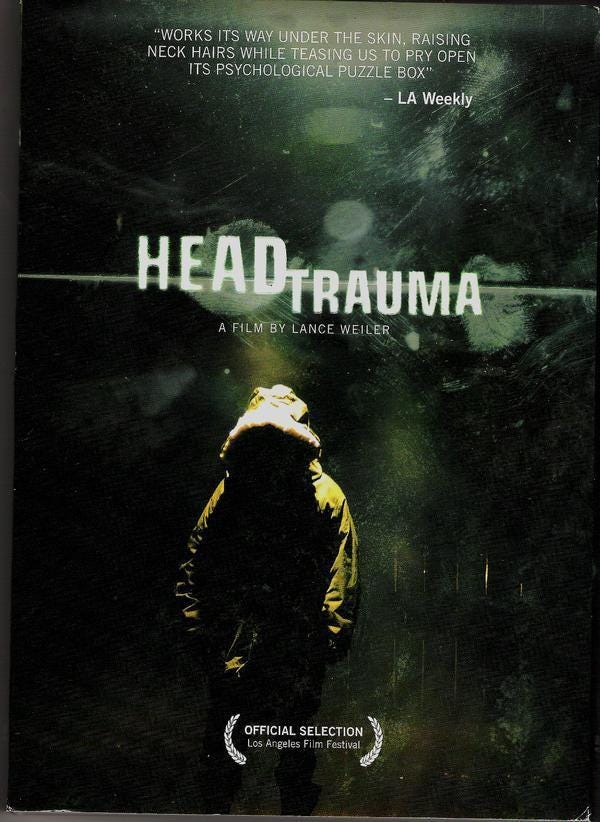
Head Trauma (Lance Weiler, 2006)
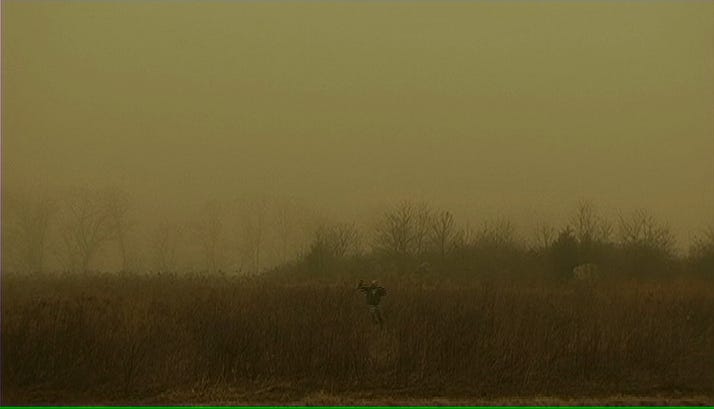
In 2006, there were still phone booths. If you were a scuzzy broke guy with a lot of demons chasing you, you could use a phone booth to call the city and try to stop the demolition of your late grandmother’s condemned home in a run-down suburb where it’s always cloudy and everything’s tinged a pallid yellow-green. You didn’t need a cell phone yet, in 2006, which was good, because you obviously couldn’t afford one. You were sleeping in a bag on the floor surrounded by trash and you had the sort of beard that guys only grow when they’ve become too depressed and alcoholic to really give a fuck how they look anymore. You need that phone booth. You need it because, fishing hopelessly for forgotten change in the coin return slot, that’s where you’ll find the pamphlet, the one with the full moon and the hooded figure rising over the unquiet water, the one that says “NOTHING BUT GRIEF”. You need to find that pamphlet. It’s what will unlock everything. It’s what will stop the process, which won’t be pleasant, but will necessary. It’s what will force you to face your demons.
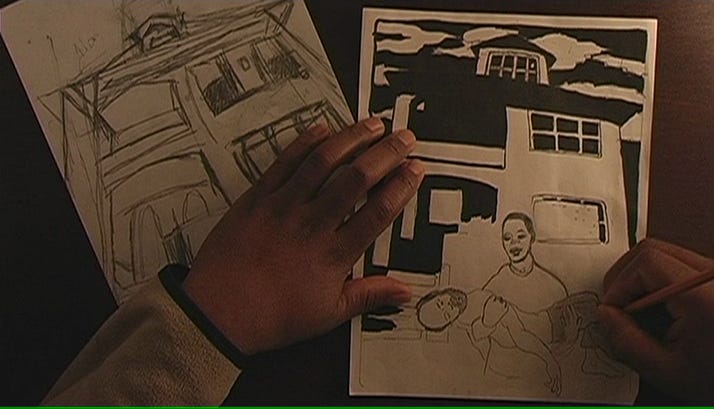
Head Trauma is one of those horror movies where much of the dramatic tension hinges on the extent to which everything scary that’s “happening” is or is not just a product of the protagonist’s damaged brain. I think this is, generally speaking, one of the the less interesting conceits to make a horror movie out of, but I don’t mind it here because the value of this film doesn’t really have much to do with how the narrative resolves itself. This is a film which is compelling first and foremost because of simple, grounded, evocative way it draws its world and the people that inhabit it. It’s a world which feels specific, in place and in time, and yet somehow not quite real, like a kind of grimy reverie, a memory of a place, not the place itself. A lot of this is the locations, of course, and the stridently grainy, unbeautiful mid-aughts DV cinematography, but it has to do with the cast, too: all unknowns with few other credits to their name, all delivering solid enough performances, and all looking like neither actors nor regular people, but specifically regular people trying to look like actors. They look aspirational, stuck in a place where those aspirations will go nowhere, and this is exactly the affectual register the whole film operates within. Beyond this, though, I think Head Trauma’s value is to a significant extent simply a matter of it being an independent American horror film with meaningful dramatic ambitions from a time when independent American horror films with meaningful dramatic ambitions were not yet conceptualized as potential subjects of “discourse”, when such a concept did not really exist at all, not as it does today. This is important because it means it does not occur to the film that it should be something other than a low-stakes, downbeat character study, almost a kind of Sundance thing but with a harsher edge, with a creepy house and people hanging from trees, to be about a guy having bad dreams and taking pulls from a flask and freaking himself out while trying to get his shit into some semblance of togetherness – to remain, that is, concerned with properly cinematic matters, like how light can bounce around inside a flooded basement, and properly human ones, like bonding with your neighbor’s grandson after he throws you off your porch. This is a small film which tells a small story using modest means, and it’s only a little scary, and this is all how it should be. I liked spending time with this guy, even though he’s a scuzzy loser. I liked that everything felt grimy and grungy in that distinctly Bush era way. I liked its regionalism, that it was clearly shot in a part of the country (I think the suburbs outside Philadelphia?) where things aren’t usually shot, not to represent themselves, anyway. I liked seeing who he would meet, and how these encounters would further sketch out a history which, really, never becomes much more than that, and doesn’t need to be anything more than that. The idea is enough, for a movie like this, the outline of the thing, the weird drawings in the attic, the tooth jammed between the floorboards. You don’t need more than these things. You don’t need to a larger point than that sometimes people’s lives get fucked up, and keep getting more fucked up, and they don’t know how to deal with it until they do. It’s enough. It’s enough.